
The Otto Specht School Blog
Words of Wit and Wisdom

Farm and Garden: Spring Update
Although there is still a nip in the air and snow on the ground, the classes working in our greenhouses are anticipating spring! Several of our plants have been left to set seed for next year, including radishes and lettuce. Even in the depths of winter we were able to sell some of our beautiful rainbow chard at the Hand and Hoe, bringing in $50 to support our farm and garden programming.
Although there is still a nip in the air and snow on the ground, the classes working in our greenhouses are anticipating spring! Several of our plants have been left to set seed for next year, including radishes and lettuce. Even in the depths of winter we were able to sell some of our beautiful rainbow chard at the Hand and Hoe, bringing in $50 to support our farm and garden programming.
While academic skills are practiced in a very concrete way within the garden - counting, measuring, and so forth, it is also important to highlight some of the other capacities we nourish in this setting; forward-thinking, confidence, and hope. Some of the students have begun to think ahead a couple of seasons in order to prepare for what is coming in the future in our gardening curriculum. This term, the High School verse speaks of the hope that comes from performing tasks with a vision in mind. They can ground this in the reality of having grown almost 100% of our crops this year from our own seed. The students feel a sense of assuredness and confidence in watching this years' plants send up tall stalks destined to flower and set seed. Growing food for the community gives us hope as we watch the cycle of nature in the turning seasons and see dinner plates brightly colored with food we have grown all throughout the year.
There are many other things that students are looking forward to on the farm as well. Flats are being filled with soil for seeding brightly colored flowers such as cosmos, zinnias, and sunflowers. Young lettuces and herbs are sprouting, and the earth's gradual thaw is allowing us to plant grassy walkways for summer strolls amongst the flowers. Of course, we are all excitedly anticipating Otis' arrival later this Spring and have been preparing the space for him. The riding ring is being cleared of rocks and debris, the stable is cleared, a proper floor of mats laid down, and stalls are being built in the coming weeks!

In Our Words
When our students discover that they are writers, a whole world is unlocked within them. Our work as educators is to give them the keys. The main lesson teachers and our reading and writing specialist, Elizabeth Harriman, work to remove obstacles and anxieties and provide students with tools and guidance along the way.
When our students discover that they are writers, a whole world is unlocked within them. Our work as educators is to give them the keys. The main lesson teachers and our reading and writing specialist, Elizabeth Harriman, work to remove obstacles and anxieties and provide students with tools and guidance along the way.
student writings
Elementary School Poetry
The Sweetness of Syrup
by the Third Grade
Maple syrup is sweet.
You can even use it with meat.
It's sticky as glue,
It's not blue.
The sap is boiled all the way,
Sometimes it takes all day.
It is sweet and sticky,
Maple syrup makes you very licky!
In the Forest
by Shelby Yager, Grade 5
A forest is a splatter of paint, simple, yet expressive.
A forest is a glistening gem, precious and unique.
A forest is a faded shirt, ordinary yet extraordinary.
A forest is an aromatic vase, full of the most delicate roses.
A forest is a whisper, it’s an icicle, it’s a song.
A forest is an exclusive club, special and divine.
A forest is a cushy pillow, comforting and welcoming.
When I walk into a forest, straightaway, nature’s song is sung.
As a blue bird flies by I think:
A forest is the place that I really love to be.
Middle School Short Stories
In this assignment, the middle school students were told about a person at one moment in his life. It was up to them to imagine his story before and after. Below, are the introductions to each of their stories.
Zachary Pace
Vouk sat down on a dormitory bench with a coffee in one hand and an intermediate Chinese book in the other. He had come all the way from Yugoslavia to China to get his Master’s Degree in Chinese. He missed his family. He remembered how his sister had thrown her arms around him like a bear, begging him to stay, while his father reassured her. He remembered his mother wishing him good luck, and best of all, his cat rubbing and purring against his legs. He smiled to himself. These memories comforted him. He bent over and took up the newspaper, scanning through it quickly. He didn’t know what he was looking for but he had a feeling something he needed to know, something important, was in it. As soon as he saw the headline, his mouth turned dry as a desert. He was afraid but he began to read the article. The first few words said, “ Yugoslavia at War.” He stopped in shock. What was he going to do? Should he stay and become a citizen of China or go and try to save his family?
Jaisaiah (JJ) Savage
Hello, my name is Yugo and this is my story. I was born and raised in Yugoslavia, in a small village that looked like a strip mall, with vendors everywhere. I lived in a small house with my mom and my sister, Mai. Mai was five years younger than me. She was cute like a rabbit, goofy, and sometimes annoying, but I still loved her. Since mom was usually out working, we only had each other. Sometimes mom would come back really late so I would have to tuck in Mai myself. Mom would act like everything was ok, but I could see she was suffering. Whenever she came home late she would give Mai and me treats from the market. She was a kind, hard working, and strong woman. Now, you may be wondering about my dad . . .
Masai Marchan
There was a time long ago when there was a country called Yugoslavia. In it loved a boy named Kai. He lived in a very rich town. He never had to worry about money. Kai went to a prestigious school - a smart boy indeed. One day he was walking home and he got a letter. It was a scholarship to the University of Shing. He was so excited that he ran into the living room and told his mom the good news. She was proud of his accomplishment so she bought tickets to Beijing. Right away, they started packing for the move. The big move was only a week away. Kai said he was so excited, he could not stand it.
High School Poetry
Freedom – Oppression 1
By Kesshem Williams, Grade 10
Cold an untold hold
on your body but your
mind is free but physically
you have been stuck in the
world’s perspective see cause
as long as I can remember
I’ve never been free.
Freedom – Oppression 2
By Kesshem Williams, Grade 10
I’m trapped in a mission
with decisions that aren’t my
choices. Captured in a society
where my body is rashful
but my mind is roaring.
if I had one glimpse of
freedom I’d end my
story right there right
then cause I couldn’t be
captured again.
Untitled
By Kesshem Williams, Grade 10
scratching and pulling
at your emotions hoping
you can find happiness
again. Frustration bashing
around in your head thinking
of things you shouldn’t
have said but there’s
this warm feeling in
your chest telling to hold
your head because mistakes
are food for knowledge.
The Man Who Lived For Years
By Kaito Maekawa, Grade 10
I am a person who lived for years.
I have seen everything change over my life.
I have been to this place before.
But I used to see a beautiful sundown over the buildings.
I remember a woman that I love.
I thought I lost her during a fight.
But she managed to survive the tragedy,
and her descendant is standing before me,
singing the song that we sang together.
Us and They
By Kaito Maekawa, Grade 10
We ride on machines.
They ride on animals.
We can’t ride animals.
They can’t ride machines.
We buy food.
They hunt for food.
We don’t know how to hunt.
They don’t know how to buy.
We write words.
They write pictures.
We don’t know their pictures.
They don’t know our words.

Farm and Garden: Winter Update
Fall harvest is winding down in the fields of Duryea Farm at the Fellowship Community. Otto Specht third graders along with farm educator, Jose Romero Bosch, finished bringing in the last of the lettuce they planted earlier this fall before winter snows set in. As the weather outside turns cold, however, and the ground begins to freeze, inside the greenhouses warm temperatures and healthy soil allow us to continue growing and providing fresh produce to the members of the Fellowship Community. This fall, students threshed seeds they had saved from last year’s crops. Now, Greenhouse 2 is filled with vibrant beds of rainbow chard, radishes, and a variety of lettuces grown from these seeds. Just last week, high school and middle school students planted over 300 more radishes and 125 more lettuces, which will be greatly enjoyed at midwinter meals.
Fall harvest is winding down in the fields of Duryea Farm at the Fellowship Community. Otto Specht third graders along with farm educator, Jose Romero Bosch, finished bringing in the last of the lettuce they planted earlier this fall before winter snows set in. As the weather outside turns cold, however, and the ground begins to freeze, inside the greenhouses warm temperatures and healthy soil allow us to continue growing and providing fresh produce to the members of the Fellowship Community. This fall, students threshed seeds they had saved from last year’s crops. Now, Greenhouse 2 is filled with vibrant beds of rainbow chard, radishes, and a variety of lettuces grown from these seeds. Just last week, high school and middle school students planted over 300 more radishes and 125 more lettuces, which will be greatly enjoyed at midwinter meals.
For our school, winter is not a time of barrenness and indoor days. As greenhouses continue to produce fresh food, last year’s harvests from our Therapeutic herb garden are being used to create products that will help keep us healthy all year. Students have made sachets of fragrant, healing herbs and balms and salves with calendula and herbs. Second graders made a variety of teas from their garden and are now working to build raised beds for next year’s crops. Dr. Johnson made many blends of healing teas and was able to sell several bags at the annual Fellowship Holiday Fair while still saving enough for use at the Fellowship.
Through the cycle of seasons, our students learn and develop skills that connect them to each other and to the natural world, that foster connections to other academic lessons, and that provides nourishing food for the greater community. As the warmth of summer lives on deep inside the earth while the outside is barren and still, we offer gratitude that we are able to be a part of the cycle of the year through our outdoor and agricultural education.
The Outdoor Classroom
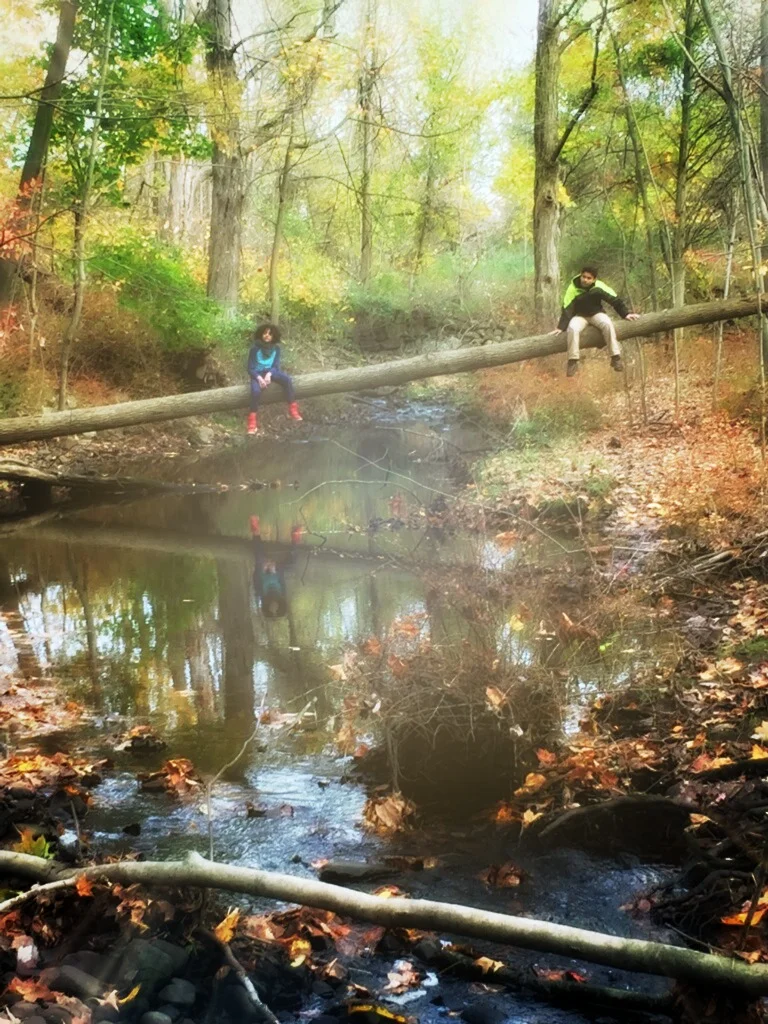
Outdoors, in forests and fields, our lessons are ever-present. They do not dwell in the realm of theory and abstraction. The children remain awake to each other and to their surroundings. They problem solve, help each other, and follow along – not simply because the teacher has created a set of instructions, but because the group is moving, because the water below is wet, because something else is around the next bend.
We cross the creek with its melancholy meander or cheerful gurgling; up the hill and through fields, now browning, singed from frost - past the great, old oak whose leaves, curled, stiff, and brown, hang on with determination, long past the baring of maple, walnut, or poplar. Where did the acorns go that pelted the ground last week? The chattering squirrels, scolding us for stopping too long by the oak have them hidden away for winter. Some they will forget and new oak trees will grow. From here we turn into the woods towards Indian Rock, where we stop to climb or rest before continuing on to further fields, the fields where the cows came to graze in the early fall. Familiarity has changed these places, made them ours. We know them - even when the leaves are gone, and nothing remains but the unclothed structure of our landscape.
Outdoors, in forests and fields, our lessons are ever-present. They do not dwell in the realm of theory and abstraction. The children remain awake to each other and to their surroundings. They problem solve, help each other, and follow along – not simply because the teacher has created a set of instructions, but because the group is moving, because the water below is wet, because something else is around the next bend. One student, jovial and animated, leads the others in trail songs. Even the melancholy, hard to move middle schooler joins in the song as he helps another student, less agile, less sure of herself, across the creek. Students begin to open up, to breathe more easily, to quiet the chatter. Under the canopy of leaves, one student, often holding her arms close to herself, opens them wide and, looking upwards, twirls with the falling leaves. Some students fly through the forest, seamlessly hurtling fallen trees, while others choose their footing carefully along the path. When a band of deer comes in sight, we all stop in silence, watching them pass as though witnessing a magical spectacle. And we were – but the spectacle the deer were witnessing was just as magical; the unstrained silence of a group of students, forgetting their differences, unhindered by their challenges.
In Their Words:
"This week the weather became cool. Now that it's sunny I like to play outside and go hiking. The leaves are changing colors and falling from the trees. The geese are flying north. It's good weather for weeding and harvesting." Giancarlo Young, 16
Curriculum Spotlight: Introduction to Eurythmy in the Classroom by Elsa Macauley
Eurythmy is an art form that is FUN! It also takes concentration. When working with Eurythmy, the lessons are planned according to the development of the growing child so that there is enough challenge to allow for individual growth, and enough success to build self-confidence.
Eurythmy is an art form that is FUN! It also takes concentration. When working with Eurythmy, the lessons are planned according to the development of the growing child so that there is enough challenge to allow for individual growth, and enough success to build self-confidence.
I began doing Eurythmy as a part of my Waldorf Teacher Training when I lived in Chicago. I loved the way that the sounds of speech were able to become gesture so that poetry could be moved. I began to experience the spoken word in a new way.
In my youth I enjoyed singing in choirs and playing percussion in band and orchestra. I also had a love for poetry and theater. After doing Eurythmy, I was amazed that there was an art form which existed to help us deepen our relationship to language and to music while building new dynamic movement skills.
These skills helped me to integrate what I was hearing into my own body. My movement became an expression for poetry, grammar, rhythms, musical tones and intervals. The forms which we moved in space were challenging to remember, and my consciousness had to be both within myself and in the surroundings. I became more aware of the influence my movements had on those around me. My coordination improved, and my thinking became clearer and deeper.
After having these experiences, I decided that I would become a Eurythmist. I graduated from the Waldorf Teacher Training and moved New York to learn Eurythmy at Eurythmy Spring Valley. After four years of full-time study I graduated and began to teach children and adults.
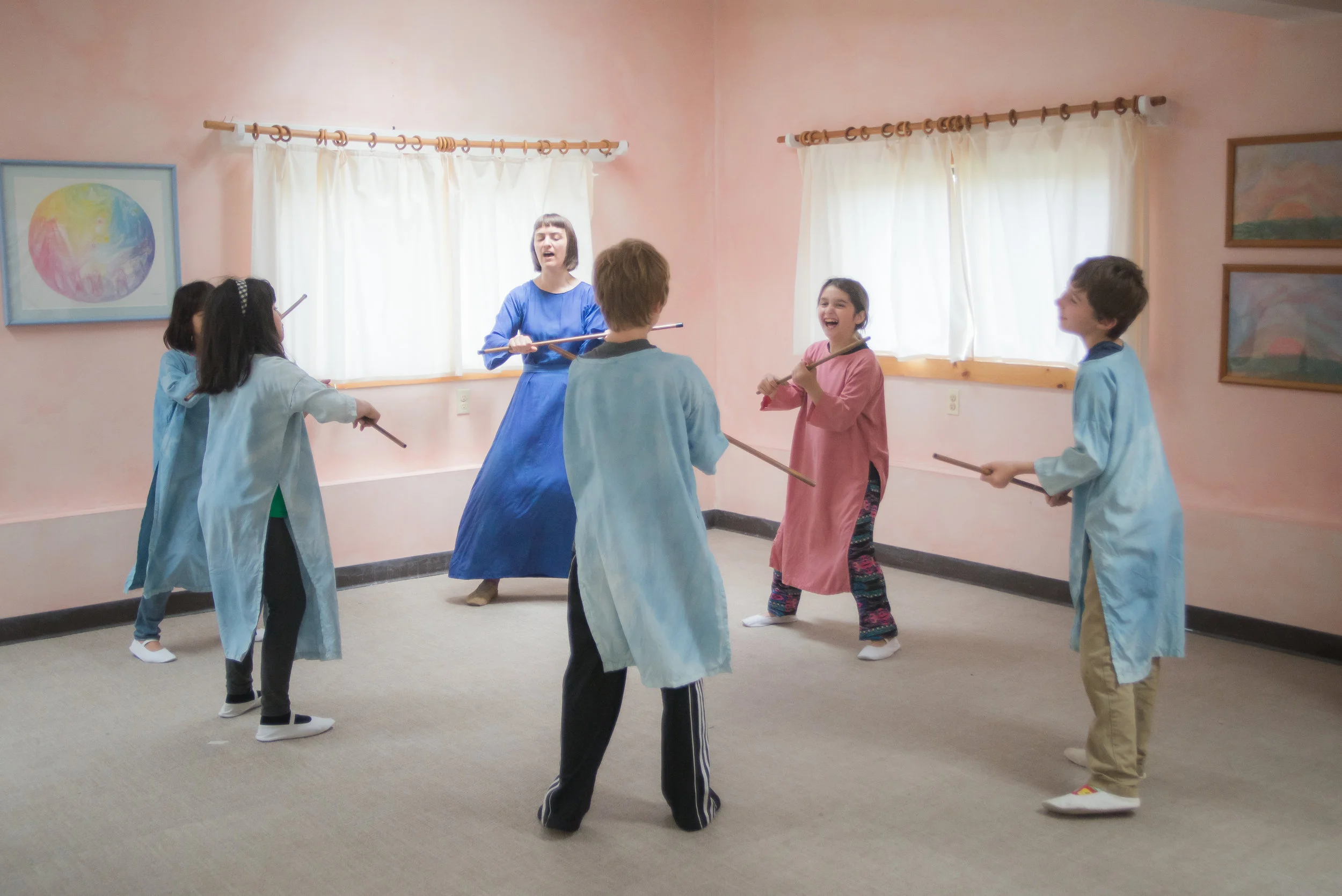
Depending on the age of the children in a class the activities will differ. Each class includes poetry or stories which relate to the curriculum accompanied by movement gestures of the sounds of speech; choreography in space of straight and curved lines in various degrees of difficulty including mirror picture forms and geometric forms as the children grow older; work with copper balls or rods to allow the children to find their own center as well as interact with each other; and musical elements of melody, rhythm and beat.
The fifth grade is now working on moving the five-pointed star which is the geometrical archetype of many flowers. To move the star together they need to be able to both know their own path of travel from one point of the star to the next, and be aware of the others so that they pass without cutting anyone off. They are at once centered within their own intention and movement and aware of those around them.
To complement their botany block, I’ve brought them the photographic work of Karl Blossfeldt. After looking through a book of his complete work, one of the students said, “Karl was a genius!” The students picked out several photographs of flowers, for which they then came up with forms and gestures. The photo shown is the first of Karl’s photographs which we moved in space.

In middle school the students are going through a lot of changes in the growth of their bones as well as a new experience of their inner emotions. In class, we are focused on regulating rhythms as well as going into levity and gravity. One of these students recently wrote a short paragraph about his experience of his Eurythmy class. His last statement was, “At the end of every Eurythmy class I feel enlightened.” Of course, as a Eurythmy teacher I can’t be more pleased to hear this! Pedagogical Eurythmy strives to allow each student to come to a deeper experience of themselves and to bring them into harmony with the world. - Elsa Macauley


Eurythmy Class, written by JJ Savage
In my eurythmy class there is a multitude of activities Masai and I do. First, we swap out outside shoes with our eurythmy shoes. After that, we take eight eurythmy rods and set them up like train tracks. Then we use the formation of the rods as an obstacle course. Next we do a geometric form using our arms and legs. Later we balance the rods on our heads and walk back and forth. Finally, we end with a closing verse that includes eurythmic movements. At the end of every eurythmy class I feel enlightened.
Of Horses and Waldorf Education by Jose Bosch
As horses, they also don't pretend at anything else - they behave however they are feeling - anxious, bold, relaxed, confused, and so forth. In working with horses, we need to be for them exactly who we need to be for ourselves when we struggle with feelings such as anxiety, fear, or confusion. This process - the process of finding a way to be for the horse what we need to be for ourselves, is the most powerful benefit of working with horses.
Winston S. Churchill once said, “There is something about the outside of a horse that is good for the inside of a man”, and I could not be more in agreement. When I was six, my father took me to a local trail barn for my first horseback riding experience. While the string of horses were being saddled, I wandered over to a nearby fenced pasture, admiring a large dark bay horse standing at the top of a hill in the distance. As I climbed the fence rail for a better look, the horse turned suddenly and began to gallop in my direction. He bound directly towards me, covering the ground quickly with each graceful, powerful leap. I stood there, frozen to the fence rail in awe and fear, when this large creature slid to a halt just a few feet from me. I could not move. The horse towered over me, breathing me in and out, his head high above mine. Our eyes locked. Taking one more deep breath in, the horse's nostrils flared and he exhaled vigorously, blowing wet, cold snot all over my face. The horse turned and walked away, his interest in me satisfied. I, on the other hand, was hooked. "Horse fever”, well-known by equestrians everywhere, took me over and never left.

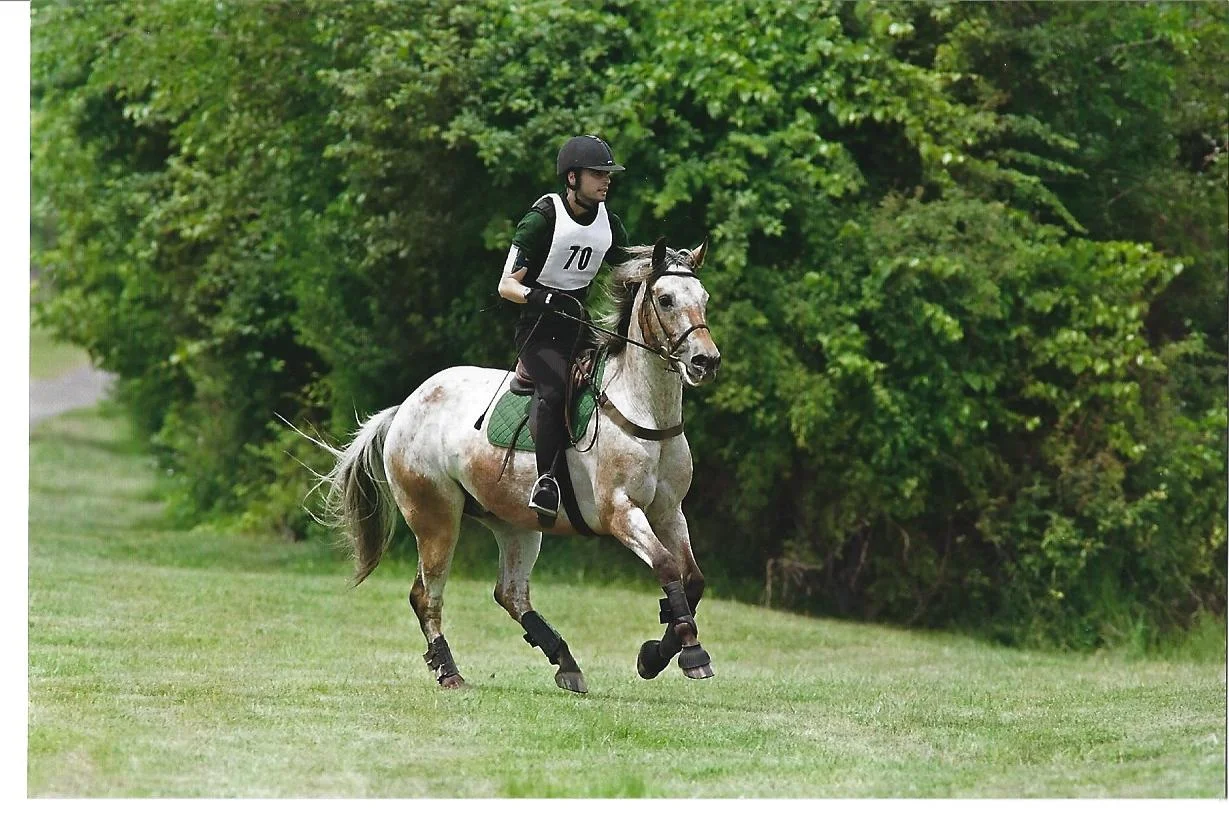
Jose and Otis in their previous careers as competitive Cross Country horse and rider.
Many years later, a professional equestrian trainer, I had the pleasure of working with a fellow trainer in her therapeutic horseback riding program. I saw before me the magic and power of those horses helping the inside of humans in need. The children and adults served by this program were struggling with Autism, Sensory Integrative Dysfunction, Learning and Language Disabilities, Attention Deficit Disorder, Developmental Delays, Emotional and Psychological Challenges, and more.
How can one animal provide so much benefit to such a range of individuals? The answer lies in the horse’s natural makeup and has been known since Hippocrates wrote about the horse’s therapeutic abilities for humans in 400 B.C. First of all, a horse's physical constitution and movement benefits riders with diverse needs. The horses natural gait, which mimics that of a human – variable, rhythmic, and repetitive – coupled with the animal's body warmth, provides a combination of sensory, motor, and neurological inputs that deliver a wide array of therapeutic effects. Equine assisted activities and therapies are now widely recognized as having a spectrum of benefits both physical and psychological, that often supercede the effects of traditionally administered therapies. Studies have shown that the benefits of Equine Therapy include improvements in assertiveness, emotional awareness, empathy, stress tolerance, flexibility, strength, impulse control, and interpersonal relationship skills to name a few.
However, the greatest benefit horses have for children and adults struggling with ADHD, autism, and other learning, developmental, and social, emotional, or psychological challenges, is that the horse is a mirror of these struggles. Horses are prey animals, prone to nervousness, suspicion, and hyperawareness. As horses, they also don't pretend at anything else - they behave however they are feeling - anxious, bold, relaxed, confused, and so forth. In working with horses, we need to be for them exactly who we need to be for ourselves when we struggle with feelings such as anxiety, fear, or confusion. This process - the process of finding a way to be for the horse what we need to be for ourselves, is the most powerful benefit of working with horses.
As Waldorf teachers, we have learned to work inwardly, to develop capacities and forces so that we can help foster the healthy development of our students. Working with horses will allow our students to develop their inner capacities to overcome challenges in life. Since being at Otto Specht School, I have seen incredible break throughs, moments of joy, and connections made. I look forward to guiding students in the unique experiences that caring for and riding on horses will bring.
#Giving Tuesday OSS
Otto Specht School has joined #GivingTuesday, a pioneering effort to harness the collective power of partners charities, families, businesses, and individuals. The movement is transforming how people think, talk about, and participate in the giving season. Black Friday, Small Business Saturday, and Cyber Monday have become recognized days of holiday shopping. #GivingTuesday brings attention to philanthropy, donations, and kind actions - a movement we can really get behind!
Otto Specht School has joined #GivingTuesday, a pioneering effort to harness the collective power of partners charities, families, businesses, and individuals. The movement is transforming how people think, talk about, and participate in the giving season. Black Friday, Small Business Saturday, and Cyber Monday have become recognized days of holiday shopping. #GivingTuesday brings attention to philanthropy, donations, and kind actions - a movement we can really get behind!
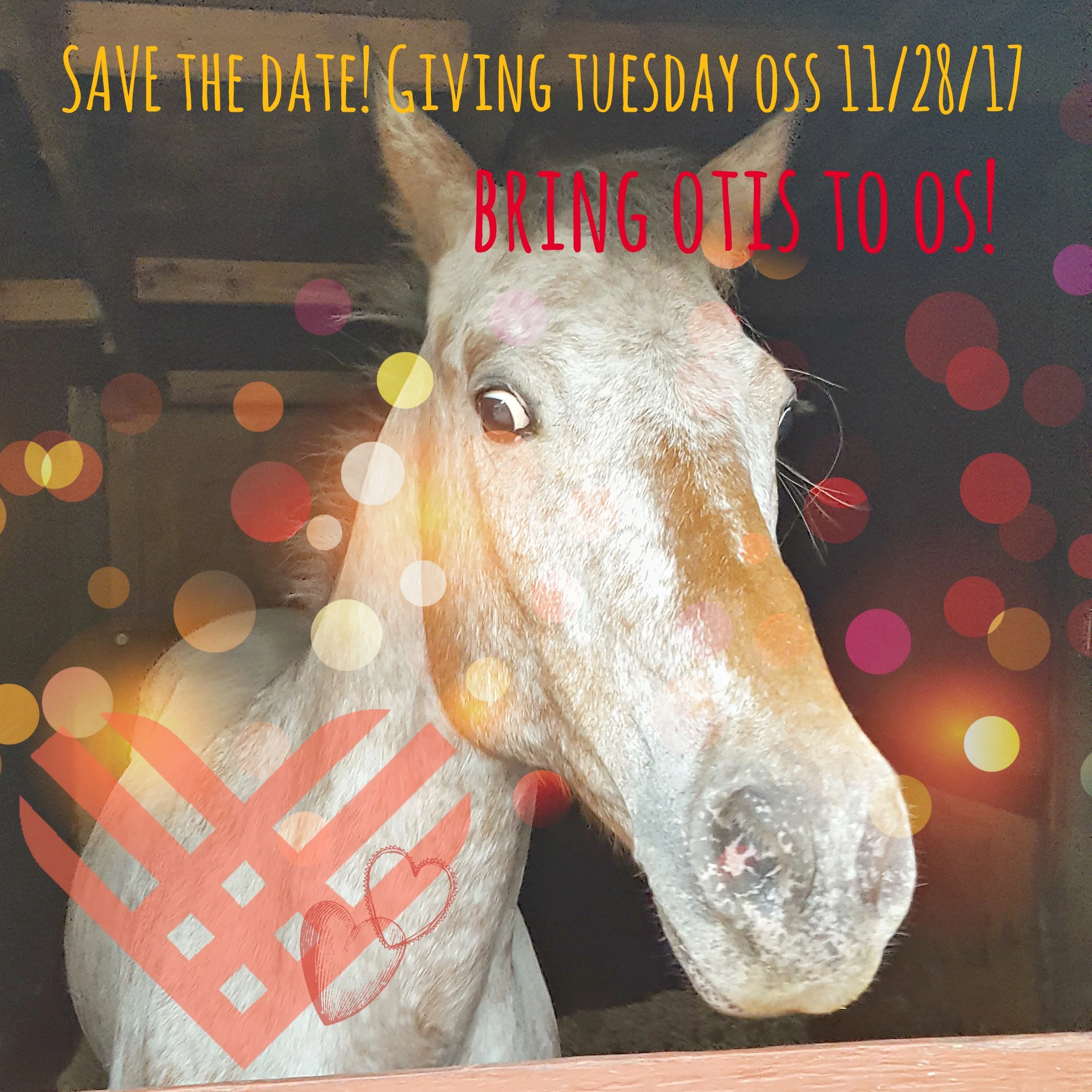
We encourage you to give a gift on Tuesday, November 28, 2017 that will help bring the horses home to OS! We are so excited to be adding rescued mustang Otis to our staff to begin our Therapeutic Riding program! Your donation will help us complete the infrastructure he needs, find him a friend, and provide the necessary care, food, and supplies. We are fortunate to have been gifted the horse and some supplies already and now we need you to get us the rest of the way! Join together with the Otto Specht School community by making your gift on this national day of giving. GIVE NOW! This year, every dollar you give to support Otto Specht School on #GivingTuesday will be matched (up to $6,500) by parents and teachers who are willing to go the extra mile to make this happen and challenge you to get involved as well. With this exciting incentive, we are hoping to outdo ourselves.
If you have been waiting until the right time to make a gift, this is it. And if your employer offers a match, you are in a unique position to TRIPLE YOUR IMPACT.
Please consider making a gift in honor of a friend or family member. In doing so, you will be able to share Otto Specht School with someone who might otherwise not know about us. By introducing new people to the school now, you are creating the potential for supporters in the future. We also ask that you share our messages on Facebook, Twitter, Instagram, LinkedIn, and of course by word of mouth. Your endorsements and support are critical to the success of this one day campaign.
In the spirit of #GivingTuesday, I hope you will make your gift to the school on November 28th, so that it will be twice as powerful!
Have questions? Contact Chela Crane at ccrane@ottospecht.org.