
The Otto Specht School Blog
Words of Wit and Wisdom

Farm & Garden Update: A Practical and Radical Experiment
As American Novelist Wendell Berry wrote, “the true measure of agriculture is not the sophistication of its equipment, the size of its income or even the statistics of its productivity but the good health of the land.” Healthy topsoil in which healthy food can be produced and fed to people to promote health, takes hundreds of years to build and create, but in just a few years can be destroyed. One would think humans would have learned these lessons by now, especially here in the States, having gone through the Dust Bowl about a century ago. Agriculture, with its advanced technological knowledge, mostly in the field of genetic research, is taking a radical shift in food production, but it is not towards more preservation and protection of our planet's resources. With these shifts, one might think more technology will fix our environmental and health crises. But what if it does not? What would the alternative look like or be? What would be the fix? How will humanity continue to feed an ever-growing population with rapidly depleting topsoil, increasing droughts, increasing air and water pollutants, decreasing biodiversity and decreasing ecological habitats?
As American Novelist Wendell Berry wrote, “the true measure of agriculture is not the sophistication of its equipment, the size of its income or even the statistics of its productivity but the good health of the land.” Healthy topsoil in which healthy food can be produced and fed to people to promote health, takes hundreds of years to build and create, but in just a few years can be destroyed. One would think humans would have learned these lessons by now, especially here in the States, having gone through the Dust Bowl about a century ago. Agriculture, with its advanced technological knowledge, mostly in the field of genetic research, is taking a radical shift in food production, but it is not towards more preservation and protection of our planet's resources. With these shifts, one might think more technology will fix our environmental and health crises. But what if it does not? What would the alternative look like or be? What would be the fix? How will humanity continue to feed an ever-growing population with rapidly depleting topsoil, increasing droughts, increasing air and water pollutants, decreasing biodiversity and decreasing ecological habitats?


OSS North is an exploration of these questions. The project began in 2020 with the purpose of creating a self-sufficient micro-farm combining Biodynamic practices with permaculture methods to explore non-traditional agricultural techniques as possible solutions to the current worldwide environmental crisis humans are facing. At the same time, it provided a complete farm and garden educational experience, bringing the Otto Specht students into this practical and radical experiment.
During the 2019-2020 school year, in the months before Covid closed down the schools, OSS students in all grades took the first of many steps. They began by observing the land, taking note of the many unique characteristics of this space. In autumn, the students noticed the slope of the land and how the rain flowed from the upper to lower parts. They looked at the contours of the space during winter when all the vegetation was dormant and the skin of the Earth covering the space was bare. In spring, the students took inventory of the various species of plants living in the space, vying for ground and light, creeping up the hillside and transforming what was once opened and cleared land back into forest. High school seniors explored key-line principles based on topographic lines as well as concepts like desertification and edge effect. Other High School and Middle School students focused on forest growth stages and which plants are present in each age of development, as well as the 7 levels of plant strata from tubers to vines. Lower grades concentrated on the movement of the Sun through the cardinal directions and the effects on plant growth through each from North to South. All this learning supplemented their respective curriculum and development.
At last, with their will directing their hands and feet, armed with nippers and small pruning saws, the students peeled the pioneer plants and shrubs back to the edge of the well established forest. Proudly, they had reclaimed the land and the birth of OSS North was witnessed. A point was then found in the contours of this new space where the decline of the hill meets the leveling off of the flat ground. That point and the topographic contour line that lies along it formed the point from which all the beds in this new garden would align themselves with, and in doing so, rain water and surface erosion of precious topsoil could be trapped and held on the new growing space for years to come.


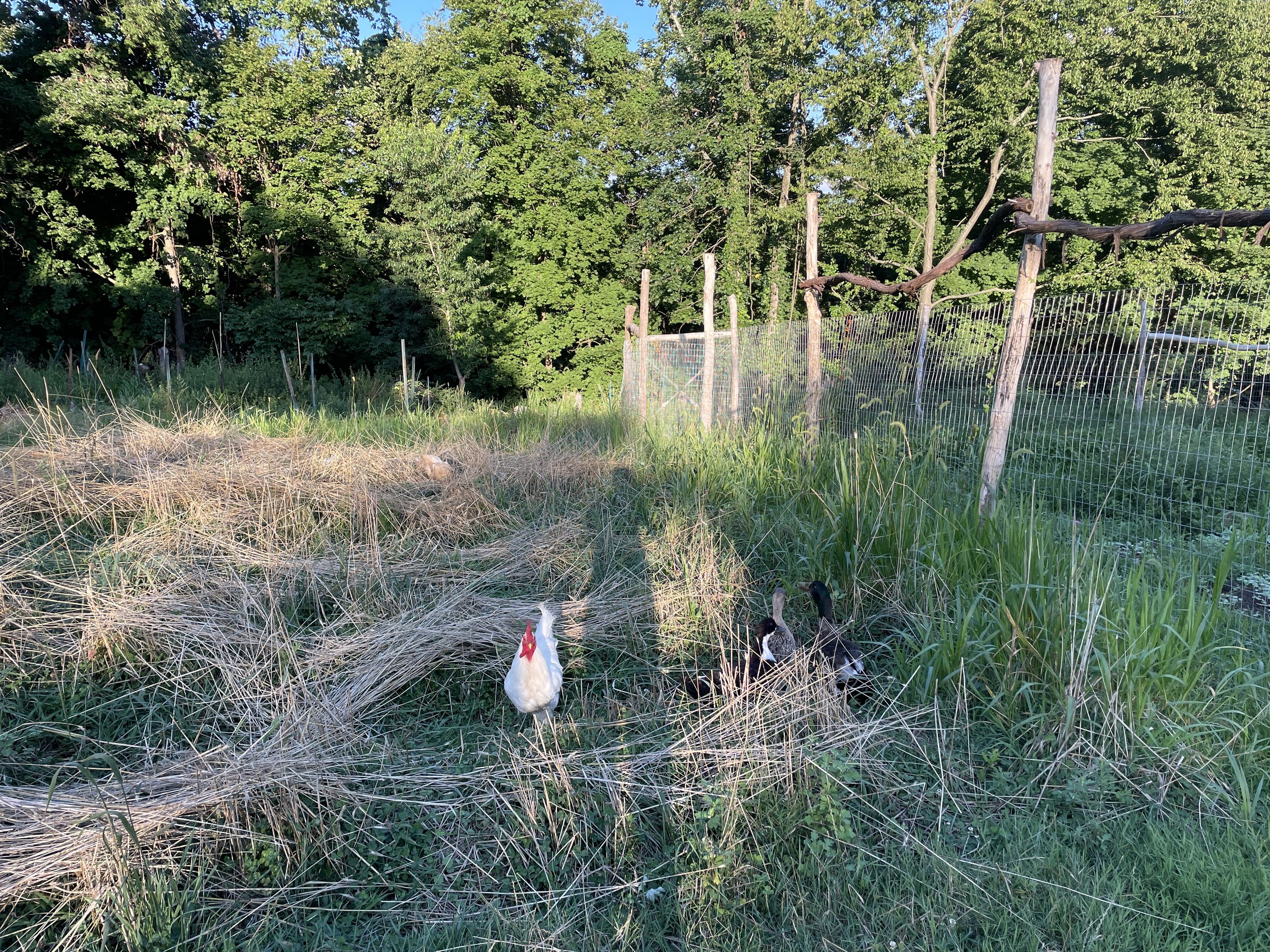
OSS is now embarking on its fourth year creating this small example of what agriculture could look like even in the midst of our technocratic, immediate gratification world. After nearly three growing seasons, many things are unfinished— we still need a fence secured with a proper gates, there are fruit trees and berry trees to plant, medicinal herbs to intersperse among perennial and annual plants, a root cellar, a pond for holding water and providing an aquatic habitat and goats to help in weed management. But in the weeks to come, students will help thresh the rye they harvested in the summer and dig the potatoes they hilled. They will measure top soil consistency and they will continue to observe the radical changes in the land. In the end, there will be no grade or test. Students will hold the rich soil in their hands, taste the fruits of their labors. The natural resources and their overall wealth and health will be judges of our practices.

Faculty Spotlight: An Interview with Deb Renna
Considering this unique moment in history (what some might call post-peak or post-pandemic), what do children, families and communities need— perhaps now more than ever?
It feels like children need form, and we all need community. During the pandemic, we were all doing whatever we needed to do to get through the days. Now children are back in school and members of a class. The children need to learn how it is to be in community again: sharing, waiting for a turn, helping one another, following the teacher, eating together, working and playing together.
Deb Renna joins the faculty as Head teacher of our Early Childhood program. She comes to Otto Specht with a lifetime of teaching experience: first as a preschool teacher for children with Special Needs in Ridgewood, New Jersey, and then as a kindergarten teacher at Green Meadow Waldorf School (GMWS). Through her years at GMWS, Deb worked collaboratively with the Otto Specht School and helped pioneer the Student Support programs for children in the Green Meadow elementary grades. Deb was the Early Childhood Chair at the Rudolf Steiner School in Manhattan before leaving that position to care for her elderly parents in their home. We spoke to Deb about early childhood education, Waldorf style, and her vision for the upcoming school year!
In a former newsletter, “Radical Reimagining” was used and this has emerged as one of the themes of this newsletter. When you hear this phrase, what does it inspire?
”Radical reimagining," to me, is an opportunity to 'clean house' and toss out what hasn't worked or old expectations, and try new things: new activities, new ways of speaking and being present with children.
How is a Waldorf kindergarten different from your typical mainstream kindergarten?
I've never taught in a mainstream kindergarten, but because I come from a family of teachers, I know that Kindergarten has become very much like the Grade 1 I attended: reading instruction, "special subjects' classes, less time outside, very little free play. In my view, Waldorf early childhood education includes a few very important features: long periods of self- directed play (inside and outside); clear boundaries so that children can feel safe and know what to expect during the school day and from their teachers; and conversations about how to be good citizens in the world. No topic is off limits, and we talk about differences and feelings, and how to make something right if we have hurt another person's feelings.


How is the Waldorf approach specifically suited for children with developmental delays, learning challenges and sensory imbalances?
The strong rhythm allows children to relax into the day. The long periods of play allow for fewer transitions which can be difficult for many children. The artistic activities are meaningful and the materials we use are natural and beautiful. Our artistic activities include: painting, bread baking, eurythmy, and coloring. Children can participate as they choose within the parameters of the activity.
How do you adapt the methods of Waldorf education to meet the unique needs of our youngest Otto Specht community members?
We have pared down the number of activities and transitions so that there is plenty of time in the day and children do not feel rushed to move along into the next activity. We are more interactive with the children, and are more explicit in our expectations of them. The young child need teachers who are grounded, warm, kind, and firm.
Considering this unique moment in history (what some might call post-peak or post-pandemic), what do children, families and communities need— perhaps now more than ever?
It feels like children need form, and we all need community. During the pandemic, we were all doing whatever we needed to do to get through the days. Now children are back in school and members of a class. The children need to learn how it is to be in community again: sharing, waiting for a turn, helping one another, following the teacher, eating together, working and playing together.
What do you look forward to most about the upcoming school year?
Seeing the children grow and develop is always a gift. Noticing that something has become easier for a child, or for the group, brings joy. Preparing for and celebrating the festivals together adds 'spice' to our school days. The joyfulness of the children is a delightful experience, especially since my own children are now grown.
Other thoughts?
The Early Childhood classroom is like a sonnet. Although there is a certain form that must be followed, there is beauty and freedom in the expression within the form.
A Parent's Perspective
Then, before he could acclimate to the therapists, "Covid hit, and everything stopped, including the services. Then he aged out.”
Re-entering a social world that Gabriel had never had the opportunity to be accustomed to was the next challenge and his parents knew they had to find a way that was not filled with sensory overwhelm or too many demands, academic or otherwise. Gabriel’s parents found a nature-based playgroup and from there were told about the Otto Specht School.
“As a toddler, Gabriel was meeting most of his milestones, but we were worried about his speech. He was saying a few words but then he kind of stopped. He was not picking up more and not using the words that he had.” Gabriel’s mother, Paulina is a certified Special Education teacher who worked in the schools as well as in homes providing SETS (Special Education Teacher Support) services. The agency Paulina worked for offered early intervention so she was more prepared than many parents, knowing what was available and how to access it. When Gabriel began Early Intervention, however, the providers struggled to connect to her son. "Whenever the therapists would come in. he’d gently push them back out the door. Just give them back their bag and jacket and wave them bye bye," Paulina says. When the therapist would return, Gabriel would spend the session clinging to his mother and crying. Before he could acclimate to the therapists, "Covid hit, and everything stopped, including the services. Then he aged out.”
Re-entering a social world that Gabriel had never had the opportunity to be accustomed to was the next challenge and his parents knew they had to find a way that was not filled with sensory overwhelm or too many demands, academic or otherwise. Gabriel’s parents found a nature-based playgroup and from there were told about the Otto Specht School.
“At first, we didn’t know what to expect,” Paulina says. “Gabriel has always been very sensory. As a baby, he never wanted to play in dirt or snow. His fists were always clenched.” When Gabriel began kindergarten last March, Paulina recalled that it was still very cold and sometimes snowy, and Gabriel would not put on gloves so his mother bought an oversized coat that covered his hands - and brought him day after day, at first for just an hour or two at a time. “Since coming here, he’s started picking up leaves, and hugging trees. Before, he wouldn’t pick up a fork! Now, he is becoming more and more independent. And he’s verbalizing more. His teachers say they have heard Gabriel say ‘Go!’ and count.” In the beginning, Gabriel would not join the group and showed little interest in the other children. “Now,” his mother says, “he is interacting more and more. He still doesn’t speak with them, but they’re working together. The last time I saw them, the children had a big pot and all of them were working on filling it with sand. And Gabriel was in there, too, taking his turn.”
“At my son’s age, social emotional skills and life skills are more important than letters and numbers,” Paulina concludes. “Here, everything is allowed to happen at its own pace. This is a school that respects children as the humans they are. They believe, as I do, that children are born with knowledge and inner guidance. They are already their own little people and we have only to help them grow into who they’re meant to be— not who we want them to be. I know that when Gabriel’s ready for something, that’s when it happens. Of course, you have to give your child the opportunity. That’s why I was searching for something—anything. Thank goodness we found Otto Specht.”
Waldorf 101: The Essentials Part 2, A Living Curriculum
“Forest health has been defined by the production of forest conditions which directly satisfy human needs and by resilience, recurrence, persistence, and biophysical processes which lead to sustainable ecological conditions.” - Nationalforests.org
The COVID-19 Pandemic shocked our educational systems much the way a natural disaster shocks and alters a landscape. This moment in education history, marked by inevitable change and potential for renewal, sparked a conversation, a “radical reimagining” of what school is. Ideas and opinions, like seeds, sought to populate the marred landscape, to regrow the forests of our educational system with something new, maybe better, but every article I read seemed somehow to be missing the point. More equitable distribution of resources and inter-district collaborations seemed like great ideas, clear improvements to the status quo, and made me excited about the new energy and enthusiasm around education but still, I wanted more. It wasn’t enough to know more information and to teach more information and to find different ways to share more information. Could this approach ever answer the imperative question being asked of us all: How can education save our fractured world? The education itself seemed fractured. The developing child was absent from the conversation.
“Forest health has been defined by the production of forest conditions which directly satisfy human needs and by resilience, recurrence, persistence, and biophysical processes which lead to sustainable ecological conditions.” - Nationalforests.org
The COVID-19 Pandemic shocked our educational systems much the way a natural disaster shocks and alters a landscape. This moment in education history, marked by inevitable change and potential for renewal, sparked a conversation, a “radical reimagining” of what school is. Ideas and opinions, like seeds, sought to populate the marred landscape, to regrow the forests of our educational system with something new, maybe better, but every article I read seemed somehow to be missing the point. More equitable distribution of resources and inter-district collaborations seemed like great ideas, clear improvements to the status quo, and made me excited about the new energy and enthusiasm around education but still, I wanted more. It wasn’t enough to know more information and to teach more information and to find different ways to share more information. Could this approach ever answer the imperative question being asked of us all: How can education save our fractured world? The education itself seemed fractured. The developing child was absent from the conversation. It reminded me of another trend arising from the time of quarantine, that of the backyard gardener. Overwhelmingly, an increase in backyard gardening is filled with positivity - mental, emotional, and physical health all benefit from the practice, and these are laudable and necessary goals for our society. However, this does little to address the concerns that sparked the trend, namely, the overall health of our food supply or the cracks in our supply chain exacerbated by the pandemic, leading to fears of food insecurity for some and real food insecurity for many others. Here, on our campus, the farm and gardens thrived, and as we returned to in person schooling, I noted as well the overall health of our educational ecology, allowing us to survive, to regenerate, to grow stronger.
“Typically, species that regenerate by re-sprouting after they’ve burned have an extensive root system. Dormant buds are protected underground, and nutrients stored in the root system allow quick sprouting after the fire.” - Nationalforests.org
Waldorf Education, rooted in human development, is now in its 101st year, but these strong roots support a living curriculum that is perpetually new and necessarily future oriented. Even as mainstream educational systems strive to create process- and learner- based curriculums, to provide individualized instruction, and to meet the diverse learners coming towards us, education policy is still overwhelmingly driven by data, an amalgam of numbers that provide a relative picture of performance based upon a variety of demographic information. Even utilizing data better and even with increased collaboration, these systems will always rely on incomplete information and never be in real time to say nothing of meeting future needs. New curriculums will continue to be written to respond to the newest information and still it will be lagging. A curriculum that seeks to know, fully, the human being, however, a curriculum kept alive by teachers who see lifetimes of possibility in each student’s eyes, will always be relevant and will always work in the present and for the future. The Waldorf Curriculum, not determined by external factors, was said by Steiner to be an education for everyone. But it is essential that the curriculum be allowed to live, to hold its truth and relevance by each teacher meeting each student.
“May the love of putting into practice what is willed to become a way of teaching for all human beings be turned into light that shines for those who feel it their duty to care for the education of all humankind!” - Rudolf Steiner
A Student's Perspective
This was written by a high school student, working on persuasive essays. He was asked to choose and support an argument through this essay. Andres, you have convinced me!
Otto Specht is a great school for everyone. I am a student here in the Specht high school. I came here last January and before Specht school was horrible. Otto Specht has had a good impact on my life.
First Otto Specht made me into a calmer person. One way I got calmer is because there is a swing in my classroom. Swinging in my class makes me calm because I focus better while I'm moving. Another reason it made me calmer is because we go on hikes everyday but have plenty of time to relax. This makes me calmer because I need to rest in order to strive. Being calm makes me into a better person because it helps me not get angry. When I'm angry I don't learn well.
A second reason Otto Specht has a good impact on my life is because it's easier for me to do my responsibilities here in school, like my school work, because I'm calmer and teachers have patience. For example, Mrs. Chin stays patient during processing. She doesn’t yell, she doesn’t say “hurry up” and she knows how to teach people who have a hard time learning. Sam also stays patient in the same way as Mrs. Chin. For example, sometimes I lay on the couch during music and meditation, and other times I walk around the room. Sam understands that that’s part of who I am. He has compassion and does music and meditation every day, no matter how tired I am.
The last reason Otto Specht has changed my life is because it makes me happy, because people are kind, and it makes me feel happy about myself. An example of kindness at Otto Specht is when people dont treat you like you're nothing. For example, people treat each other with respect, like all the time. I feel good about myself all the time because of that kindness and respect in the whole community. Feeling good about myself makes me feel happy and makes it easier to work hard.
In conclusion, OSS changed my life, and we can learn that environment is the most important quality in a school.
The Diverse Nature of the Otto Specht Forest
This is a meditation on our unique school seen through the poetry of our diverse students. The characters are named from trees, like Beech and Laurel, W. Spruce and Sugar Maple, because they and their families make up the outreaching branches of our school.
The days here are like whole seasons in slow motion, the months like lifetimes, and students grow and change with a night’s sleep making a fool of time altogether. That’s what I think anyway. I’m a teacher here, Mr. Cherry Blossom Bloom.
See if you and your students can identify themselves and their classmates.
BEECH
Beech is a student, a lot like everyone else: all trying to learn something and better ourselves, but so different in his capacities. He used to say, “I can’t”, but this year he’s been writing poems like this one:
I like the white snow falling cold on my tongue
My soul trying to keep me warm from the wind
I play in the snow packing snow balls to play.
The wind talking, swirling through the sky.
When Beech saw that he’d written that poem he shouted, “I did it! I wrote a poem!” That’s Beech, self-doubting and incredulous, encouraged and proud of it!
This is a meditation on our unique school seen through the poetry of our diverse students. The characters are named from trees, like Beech and Laurel, W. Spruce and Sugar Maple, because they and their families make up the outreaching branches of our school.
The days here are like whole seasons in slow motion, the months like lifetimes, and students grow and change with a night’s sleep making a fool of time altogether. That’s what I think anyway. I’m a teacher here, Mr. Cherry Blossom Bloom.
BEECH
Beech is a student, a lot like everyone else: all trying to learn something and better ourselves, but so different in his capacities. He used to say, “I can’t”, but this year he’s been writing poems like this one:
I like the white snow falling cold on my tongue
My soul trying to keep me warm from the wind
I play in the snow packing snow balls to play.
The wind talking, swirling through the sky.
When Beech saw that he’d written that poem he shouted, “I did it! I wrote a poem!” That’s Beech, self-doubting and incredulous, encouraged and proud of it!
CLEMENTINE
Our Clementine is an unmatched pearl: charismatic, cultured, complex and unstring-able. She reminds me of that other great melancholic, Don Quixote, when she wears her stone stubborn face and alludes to the classics. She revels in the sounds of speech and converses casually with anyone in her original renditions of French, Japanese, German, Spanish, Swedish, Dutch.. whatever you like. Her musical milieu is impeccable. She performs long, hilarious moments of improvised recitative. She puns with immunity. Never wanting attention she can’t seem to avoid it.
I heard trumpet crooning, I heard trumpet moaning.
That I heard is the trumpet crooning and moaning
I see the trumpet
The Trumpeter is Louis Armstrong
And he’s feeling sad
He’s feeling too blue
I was listening to the music I was dancing to the music .
Feeling happy
Glad
Hopeful
LAUREL
Laurel walks during class. Just gets up and walks through a room. He’s thinking, creating something, the character he has to become in order to live into understanding. His desire for knowledge is palpable, though learning is itself an unwelcome chore, so information enters by way of the circuitous paths he carves through the room. It’s like he is creating his own school wherein he learns by way of techniques honed through hours of avoiding the known routes to knowledge in favor of those which he and only he can travel. And, you know? It works for for him. Why stand in his way?
I’ve known trees
I’ve known trees who love, care, worship, fight, eat, cook and clean
With branches that grow and give hibernating animals
Life and warmth.
My soul has grown into a
Heart of a tree.
It’s beating like a bird,
Beautiful like my family
Trees survive, hard times
Trees and families
My heart has grown from hard
Times like the tree.
W. SPRUCE
W. Spruce arrived with a new haircut this week. He’s all lanky, limbs akimbo, a teenager who moves in an untethered way some trees might envy for its freedom. And still other trees would not. Easygoing, quick to smile and laugh for mysterious reasons, W’s eyes are never quite still, always reading the room for danger or opportunity, or who knows what? Always curious.
I.
The teenager with autism’s bars are reads
(Thus) works understanding.
They are chained by write understanding
Raucous
How will they break free?
Reading, understanding, sickness
II
Sunflowers are happy
They eat the sun
They revive the spirit
They understand my senses
Red barn likes him
The river friends him
SUGAR MAPLE
Sugar Maple may seem rootless but don’t be fooled, her tendrils spread in all directions seeking any suitable support. She runs with the elephants, the peacocks and the ponies; she sings arias to the pencil sharpener. And in a separate state of awareness she questions and answers questions in multiple dimensions, on multiple timelines. No longing for the past, nor pressing to the future, she strides through the present with confidence, lending credence to string theory.
The sound of the music is trying to upset
The sounds yes is Yearning and orange
The sound of the music is trying to upset.
I see together and dance Around.
See together and dance Around.
Be feeling America.
In dance around.
Heaven is together dance around.
P. ARTHUR CEDAR
In these three years, P. Arthur Cedar has reached a formidable height; towering over our forest now, we’ve watched him grow in both body and mind. Storms which once threatened to pull out his roots, now meet him and lose their power sometimes. Siren sounds on the wind and airwaves alight on his branches. And as he learns that not every wayward song needs singing, so we will see him in all his pride standing in his place, watching the world below with all the serenity he deserves.
I am the monk the king
The monk is bad and good
A little bit of both
I dream about helping people
I tryed (obsolete) to be onast (
I hope to find power
GINGKO
With her flavonoids firing and her terpenoids triggering, Gingko is healthier than a horse and thoroughly untamed. Science dates her ancestry back 270 million years, so we are patient with her education, some things simply take time. Meanwhile wisdom works its way through her eyes as she studies you openly and honestly, searches for humanity in you; and as she knows you in a moment’s glance she reflects your love... or not.
I am squire
I am musical
I dream of making sorrow disappear
I make an effort to be kind
I hope to find love
I am squire

Farm and Garden as an Essential Curriculum
Lost in my thoughts of the day, taking a moment to enjoy this newly arrived fall light as it filters through the slowly shedding limbs of trees forming the canopy covering the path, I am snapped out of my day dream world at the abrupt sound of someone coming around the bend on their way down the path. It takes us both a moment, upon entering the now shared space of the world, to recognize each other. She, who is my next door neighbor, quickly reaches for her mask in a startled manner. We laugh as we pass at the initial discriminating, protective reaction, which still feels strangely hostile despite having become so commonplace.
Rudolf Steiner spoke of changing times to come in his post WW1 future; of catastrophic conditions like poorer soil, and foods with decreased nutritional value. He spoke of the need for free thinking individuals to face the challenges ahead. In his indications for the Waldorf pedagogy, he charged the incoming teachers through the context of the curriculum to try and "put the children in the right soul mood" to face these challenges so that they may be able to create new systems and ways of doing things. In doing so, we teachers take on the monumental task of bringing our students into a balanced and healthy life, equipping them with the necessary tools, and educating and preparing their future selves to carry the torch of humanity forward.
Lost in my thoughts of the day, taking a moment to enjoy this newly arrived fall light as it filters through the slowly shedding limbs of trees forming the canopy covering the path, I am snapped out of my day dream world at the abrupt sound of someone coming around the bend on their way down the path. It takes us both a moment, upon entering the now shared space of the world, to recognize each other. She, who is my next door neighbor, quickly reaches for her mask in a startled manner. We laugh as we pass at the initial discriminating, protective reaction, which still feels strangely hostile despite having become so commonplace.
Rudolf Steiner spoke of changing times to come in his post WW1 future; of catastrophic conditions like poorer soil, and foods with decreased nutritional value. He spoke of the need for free thinking individuals to face the challenges ahead. In his indications for the Waldorf pedagogy, he charged the incoming teachers through the context of the curriculum to try and "put the children in the right soul mood" to face these challenges so that they may be able to create new systems and ways of doing things. In doing so, we teachers take on the monumental task of bringing our students into a balanced and healthy life, equipping them with the necessary tools, and educating and preparing their future selves to carry the torch of humanity forward.


Well studied in history, a keen observer of the present, and with an incredible gift of future insight, understanding before most others where the road was taking us, Rudolf Steiner, with much intention and purpose, included Farm & Garden in the original design of the Waldorf pedagogy we practice today 101 years after the opening of the first Waldorf school. Steiner fully understood, not only the value of exposing youths to wonder, to the work of the farm and all of its inherent lessons, but to the fact that the farm and garden acts as one of the last forms of true humanistic education available to us all. Although originally proposed as a subject among many, being a person of holistic points of view, I can easily assume Steiner saw the possibilities of weaving all the other subject matter the students were receiving into the Farm & Garden class, as we do in Otto Specht School. From grade 1 to 8 and beyond, there are numerous opportunities for students to apply the content of their other lessons into real world situations through the farm and garden work. Through these avenues the students engaged in Waldorf pedagogy have their capacities of intellect and physicality encouraged and cultivated, but most importantly their feeling life is awakened and engaged. In activating their soul life through the work and learning on the farm, and weaving into that work their studies and endeavors in the classroom, the academic work is further made alive and real for the students.


But it is also much more. Not only do the Early Grade children find the forms of the letters in the forest and in the bed rows of the fields, or the 3rd graders build wigwams and tipis harvested by saplings in the woods, or the Middle schoolers forage for mushrooms after a big rain and help create a Medicinal Plant Glossary by studying plants grown in the garden and turning them into different tinctures and balms, or the Upper Grades apply their physics knowledge of leverage while splitting logs and digging rocks out of empty field space in preparation for growing food to help supply the Cafe and Hilltop with Biodynamic produce, but they are learning, albeit unbeknownst to them at the moment, something far greater, more lasting and according to Steiner over 100 years ago, more imperative. They are learning what it is to be human. They are learning what it is to be a part of humanity. They are being educated for the future. For their future selves. For the future of humanity in the ever shifting world.
And why one may ask? The answer is that agriculture- the science or practice of farming, including cultivation of the soil for the growing of crops and the rearing of animals to provide food, wool, and other products, is innately a social endeavour. Food and drink is common amongst people of all color, religion, belief or creed, and in this, it is binding, unifying. Farm and garden work requires independence and collaboration. It requires delayed gratification, patience, care, intention, creativity, observation and perseverance. It requires hope. Hope that our work today will not in time be in vain. It requires communicating and respect. It requires love and thankfulness. Why do we include Farm & Garden for every grade, often first thing in the morning, 5 days a week? Because it reminds us of our humanity, teaches us to be human, and offers opportunities to come together without fear, with open heartedness, with love and respect for each other in our mutual pursuit of life. And perhaps, if we do our jobs well enough, our students and ourselves will be prepared for the times at hand when it is easier to be afraid, to recluse, to avoid each other, to divide and separate. They will be prepared to stand together and find the much needed 'new methods' and solutions that will lead generations to come progressively forward and upward in the endlessly unfolding future.

Waldorf 101: The Essentials, Part 1
In 1924, 5 years after the first Waldorf School opened its doors, Rudolf Steiner gave a series of lectures regarding education. The question he posed at the start of these lectures was the following: “What is the role of education and teaching to be for the future in terms of both the individual and society?” He pointed to a widening gap between what we know in terms of information, and what we have lost in terms of knowledge of the human being and the implications this had for the future of society and the environment. Over the next century, Waldorf Education became the fastest growing independent school movement in the world and one year ago, this centennial was marked with worldwide celebrations. As we looked into the world of September 2019, and as we turned our eyes towards the next 100 years, while we celebrated the ideas and ideals of Waldorf Philosophy, its now global reach, and the contributions to society Waldorf graduates have made, we also faced more difficult questions of where it has failed in meeting the needs of a changing world - and why? Just 6 months later, schools were shuttered, global lockdowns kept us apart, and every vulnerability, disadvantage, and inequity built into our society for years, was magnified.
In 1924, 5 years after the first Waldorf School opened its doors, Rudolf Steiner gave a series of lectures regarding education. The question he posed at the start of these lectures was the following: “What is the role of education and teaching to be for the future in terms of both the individual and society?” He pointed to a widening gap between what we know in terms of information, and what we have lost in terms of knowledge of the human being and the implications this had for the future of society and the environment. Over the next century, Waldorf Education became the fastest growing independent school movement in the world and one year ago, this centennial was marked with worldwide celebrations. As we looked into the world of September 2019, and as we turned our eyes towards the next 100 years, while we celebrated the ideas and ideals of Waldorf Philosophy, its now global reach, and the contributions to society Waldorf graduates have made, we also faced more difficult questions of where it has failed in meeting the needs of a changing world - and why? Just 6 months later, schools were shuttered, global lockdowns kept us apart, and every vulnerability, disadvantage, and inequity built into our society for years, was magnified.
The pandemic’s first shockwaves had us all diving into the unknown with the urgency to do what needed to be done for our students. We logged on, we sent packets, we created content, whatever we could do to keep connected, to carry on. Though we may not have had much time to ponder them yet, major questions concerning the future of education loomed in front of us. In the age of remote learning, as information systems replace teachers, would education survive? One year after the celebrated centennial and with a new glimpse of the future landscape, we must return to the self reflection that began a year ago with the courage to find answers. What, in Waldorf Education, moves us forward through changing times, without losing relevance, holding our course against the rip tides of societal trends so we can be responsive and not reactive? As we returned to in-person schooling this summer and fall, the answers to these questions felt present, palpable, living in the soul of our work, more noticeable perhaps in contrast to the months of separation.


When Rudolf Steiner gave his indications for the Waldorf curriculum, they came out of a direct connection to human development and an understanding of the human being that is not just physiological and intellectual but that is inextricable from soul and spirit. Teaching, Steiner told us, must come out of this understanding and through the relationship of the teacher and student. “This relationship to the teacher—the activity of the hidden forces between the child’s heart and that of the teacher—is the most important aspect of the teaching method.” This is what was so clearly present when we returned to school this summer and fall. Every day, our faculty and staff meet our students with love and appreciation, inspired to bring meaningful and appropriate content. At Otto Specht School, our students often present us with puzzles; capacities that have developed outside of the usual framework and timeline of human development, with incredible gifts and heightened intelligences, developing alongside blocked pathways of expression, and diverted connections. By understanding the developmental processes and by building strong relationships, we allow each student to guide us in his or her education. As Steiner said, “Thus, from week to week, month to month, year to year, a true knowledge of the human being will help us read the developing being like a book that tells us what needs to be done in the teaching. The curriculum must reproduce what we read in the evolutionary process of the human being.” We don’t always get it right, but each day we return to the task with open hearts, ready to try again.


As educators, we understand our task is not just for today and that our best efforts may not be seen for years to come. But if we have learned anything over the past six months it is that the world can change very quickly, and sometimes in unexpected ways. We cannot respond to global crises with information alone. Waldorf Education must have the courage to keep course, guided by these essential principles - first, that education must come from a true understanding of the whole human being and the arc of human development, and second, that education must be brought through the relationship between the student and teacher as a truly social endeavor. This will allow us to answer some of the more complex questions about the successes and failures of Waldorf Education thus far, how it will stand the test of time, and how it must move forward to reach across social and cultural divides and meet the needs of the future.

The Immune Sequence
I began working with the Immune Sequence in October 2019 when I offered a course through Eurythmy Spring Valley to the public to prepare for the cold and flu season. I worked with the exercises every day through June 2020. After eight weeks of daily work I noticed a marked difference in my breathing, which tends to be shallow, but deepened considerably. In addition, I experienced the first winter where I did not get sick once –– not even a sniffle (a miracle when passing copper balls back and forth to children with colds and flus who don’t cover their mouths when they sneeze!). When I would begin to feel under the weather, I would do the sequence an extra time and the next day felt well. As of September 2020, I still have not been sick.
I began working with the Immune Sequence in October 2019 when I offered a course through Eurythmy Spring Valley to the public to prepare for the cold and flu season. I worked with the exercises every day through June 2020. After eight weeks of daily work I noticed a marked difference in my breathing, which tends to be shallow, but deepened considerably. In addition, I experienced the first winter where I did not get sick once –– not even a sniffle (a miracle when passing copper balls back and forth to children with colds and flus who don’t cover their mouths when they sneeze!). When I would begin to feel under the weather, I would do the sequence an extra time and the next day felt well. As of September 2020, I still have not been sick.
When I began working with the sequence in October 2019, the COVID-19 pandemic was not yet a reality for the United States. The exercises were originally given as a sequence during the 1918 Spanish flu pandemic, when Rudolf Steiner (the man behind Anthroposophy, Waldorf Education and Eurythmy) made the sequence widely known to all members of the Anthroposophical Society and the Anthroposophical Hospital.
The immune sequence exercises engage self-movement and meet the human being on a conscious level, working with imaginations that relate to our experience of the world and impact the physiological workings of our rhythmic system. The movements involve both the feet and the arms, while the imaginations deepen and warm our breathing, warm our digestion, warm our circulation, and build resilience. A balanced rhythmic system supports the health of the nerve-sense system and the metabolic system helps our bodies to be a comfortable home in which to live on the earth. Warming through the circulatory system and respiratory system helps our Ego (highest self) to stay connected, grounded, and in control, and helps us to regulate the emotions of anxiety and fear which are rampant during a pandemic.
Overall, the sequence helps strengthen our immune system through gestures and imaginations that embody strength, love, hope, and letting go. It takes about 10 minutes to do and is always followed by a rest to allow the healing influences to work deeply.
Sickness is sometimes unavoidable and sometimes unnecessary to prevent, but when faced with a pandemic we can choose to be our healthiest self, building our resistance and resilience to illness with both inner and outer care. Inwardly we can build a supportive environment with health-giving content that can lift people’s spirits. This cultivates inner strength and clarity and combats stress, which can present itself on a physical and emotional level, making us more vulnerable to illness and affecting our decisions and our ability to get things done. Outwardly, we can spend more time outdoors, enjoy connecting with the earth and each other and engage in conscious warmth- giving movement activity. This can help us to feel well situated within our body.
In the midst of the fear and turmoil surrounding the pandemic, people who worked with the sequence daily found that they were empowered through the ability to take their health into their own hands by doing something self-directed and proactive. They found that the sequence offered them a deep sense of wellness and calm that lasted throughout their day. Several experienced a difference in their breathing and circulation, and most people who did the sequence every day did not get sick or found that if they did it was much less severe than normal.
At Otto Specht School, the Middle School Group has been working with the immune sequence twice a week and the High School Group does this together every day before going home. If you are interested in learning this sequence, please let us know. I would love to offer a course to teach it to you!

The Making of Mr. Leopold's Neighborhood
The idea popped up in a staff meeting one Tuesday afternoon while we sat, looking at each other with blank faces and wondering how we were going to go on as a school in the time of Covid 19. We’d just gotten word that schools were definitely closing. How could we, as a relationship-based institution, manage to keep our connections with students under this circumstance?
Mr Leopold joked, “I could do Mr. Leopold’s neighborhood!” he said, and sang “it’s a quarantine day in the neighborhood, a quarantine day from a neighbor, don’t you be mine…” Everyone laughed and Jeanette said, “I love it! We’ll do it.”
Chela picked up the ball and ran with it. She got a camera and a recorder and began booking the teachers into socially distanced segments to feature each of their courses with segues between features provided by Mr. Leopold’s songs and comments. Who knew the weeks of “sheltering at home” would drag on. Episode went to episode and what began as a modest no-budget stop gap fluff piece with slapdash editing would turn into a multi-million dollar Hollywood production…well…
The idea popped up in a staff meeting one Tuesday afternoon while we sat, looking at each other with blank faces and wondering how we were going to go on as a school in the time of Covid 19. We’d just gotten word that schools were definitely closing. How could we, as a relationship-based institution, manage to keep our connections with students under this circumstance?
Mr Leopold joked, “I could do Mr. Leopold’s neighborhood!” he said, and sang “it’s a quarantine day in the neighborhood, a quarantine day from a neighbor, don’t you be mine…” Everyone laughed and Jeanette said, “I love it! We’ll do it.”
Chela picked up the ball and ran with it. She got a camera and a recorder and began booking the teachers into socially distanced segments to feature each of their courses with segues between features provided by Mr. Leopold’s songs and comments. Who knew the weeks of “sheltering at home” would drag on. Episode went to episode and what began as a modest no-budget stop gap fluff piece with slapdash editing would turn into a multi-million dollar Hollywood production…well…
Nine episodes did get made and Chela’s editing did improve modestly along the way. Particular episodes that come to mind are “Earth Day” and “Spring Break”. We spent the Earth Day week picking up trash all around the neighborhood. Spring break turned into an imaginary vacation by the Stern family to Maine for a canoe trip; a journey to the Blue Ridge Mountains with the Damiao’s, Mrs. Irimina in Hawaii, Kinchasa at the beach, and so forth. Mr Leopold added the bookends from his hobo camp where he sang us the tales from the hardknock days “riding the rails” by poor transient laborers. Other episodes included a voyage into the mysteries of Spring flowers with Ms Patricia, Tai Chi with Mrs Chin, Farm lessons from Mr. Bosch, and of course a chance meet up with Frau Haupt and her new puppy - who obeys German commands about as well as those in english.
As the landscape changed from late Winter snows through Spring rains and the greening and flowering of the fields and forests, we waited while the social landscape changed. We learned to distance ourselves physically while holding each other firmly in heart and mind. We zoomed and zoomed here and there, over the Threefold campus, and over the ethers of internet. As of this writing we’re hovering somewhere between knowing and not knowing what to expect in the future. The theme of Mr Leopold’s neighborhood, “it’s all a big mystery to me” still stands, and perhaps he’ll be back for more episodes if circumstances (and audience) demand.