
The Otto Specht School Blog
Words of Wit and Wisdom

Voices of Us
In the nearly 10 years that I have worked at Otto Specht School, I have grown quite accustomed to speaking and writing about the unique approach of the Otto Specht School, the benefits of Waldorf Education, and the incredible unfolding we see in our students year after year. It is easy enough to intellectualize my experiences, validating our programming and various modalities with research articles on the benefits of being outdoors, the importance of movement in human development and learning, the positive outcomes from adding music and art to school curriculums, and more. It is also easy to get swept up in sharing anecdotes - telling and retelling those gratifying moments when the seeds you have sewn with your students suddenly burst forth and that student’s entire countenance beams in his or her knowing. I speak to parents, to organizations, to other schools, to educators, and to perfect strangers. I tell the stories of Otto Specht School, but they are really my stories, through my lens. So this time I decided to get to the heart of the matter, each child’s experience.
In the nearly 10 years that I have worked at Otto Specht School, I have grown quite accustomed to speaking and writing about the unique approach of the Otto Specht School, the benefits of Waldorf Education, and the incredible unfolding we see in our students year after year. It is easy enough to intellectualize my experiences, validating our programming and various modalities with research articles on the benefits of being outdoors, the importance of movement in human development and learning, the positive outcomes from adding music and art to school curriculums, and more. It is also easy to get swept up in sharing anecdotes - telling and retelling those gratifying moments when the seeds you have sewn with your students suddenly burst forth and that student’s entire countenance beams in his or her knowing. I speak to parents, to organizations, to other schools, to educators, and to perfect strangers. I tell the stories of Otto Specht School, but they are really my stories, through my lens. So this time I decided to get to the heart of the matter, each child’s experience.
I asked a few general questions and allowed students to respond in whatever way they could or desired to, whether orally or in writing, typed on an ipad, or with the assistance of an aid or therapist. As I listened and read, various clear themes arose, but the thread that connected all of these experiences was the feeling that the students are happy. Otto Specht School students genuinely enjoy school and appreciate the various opportunities they are given here. Here were the basic questions, which sometimes led to further discussions or questions expanding upon the first answers:
How would you describe Otto Specht School?
What would be two words that described Otto Specht School?
What is your favorite thing about Otto Specht School?
Emerging themes included a sincere appreciation for the farm (a big shoutout to Otis and the cows!) and all outdoor activities, for the teachers, for PATIENCE, and for our coming together on Friday mornings for assembly.
Below is a sampling of answers, as told or written:
How would you describe Otto Specht School?
“Otto Specht School is not just devoted to opening to the child’s perspectives but also to connecting with them.” - High School
“It is Waldorf.” - High School
If you could describe Otto Specht in two words, what would they be?
“Patient.” “Outdoorsy.” - Grade 6
“Fun and awesome!” - Grade 4
“Fun and learning.” - Grade 4
“Hands On.” - Grade 4
What do you love about Otto Specht School?
”My favorite activity is going for a walk. I like walking in the garden.” - High School
“My favorite class at school is Farm because I like the cows.” - Grade 3
“I like math class here.” Why? “Because I like math. They make it easier than anywhere else.” How? “PATIENCE” - Grade 6
“There are many good things at our school.
I like the farm fair because of the animals.
I have friends at school.
I like to hang out with them.
I like to do watercolor painting. I feel good about school.” - High School
“Song writing, farming, and being able to be outside.” - High School
“We get to sled. We get to play with the animals.” - Grade 4
“We get to play with Otis, the horse.” - Grade 4
“We learn a lot.” - Grade 4
“Teachers are nice!” - Grade 4
“Games, Main Lesson, German, Reading.” - Grade 4
“Lots of recess.” - Grade 4
“Greenhouse and sand pit.” - Grade 3
“I like going to the farm. I like the animals. I like going into the toolshed and seeing all the tools and choosing the tools. I like going to the pond at the end of the year - and the sugaring off party!” Grade 6
“Assemblies!” - Many (all ages)
Tell me about assemblies:
“More fun than worksheets!” - Grade 4
“Singing!” - Grade 3
“I like seeing how different people’s voices mix together.” - Grade 6
“It’s cool.” - Grade 5
At the end of the day, a high school student who has been with us since first grade said,
“Two words?
Understanding.
Embracive.”
Embracive (Adjective) 1 : disposed to embrace. 2 : inclusive, comprehensive

Where the Heart Is: Charles Rose and a Design for our Future
Geometry, natural light, and a seamless interplay with the landscape, provide viewers of Charles Rose’s architecture with the aesthetic satisfaction and feeling of awe one might experience, walking through the redwoods or a desert canyon. Mr. Rose’s interest in spatiality and attention to the surrounding environment results in buildings that are never out of place, and allow the natural elements to flow through. A number of times throughout our brief interview, Mr. Rose began his sentences, saying “By the time we get to form,” highlighting the depth and integrity of the firm’s design process. By the the time the team at Charles Rose Architects begins the actual building’s design, they have immersed themselves in intensive background work, understanding the mission and the purpose of the building, and the social fabric of the institutions and individuals who will use it. They consider the whole environment, the easy exchange between interior and exterior, the contours of the land, and how people move through the space. “ I guess I get that from eurythmy!” Charles proclaims. “Eurythmy is all about how we move within a space,” he says, adding, “I was the world’s worst eurythmy student. I had to stay many extra hours for bad behaviour.” Charles views his Waldorf Education as a significant component of his architectural work and the overall worldview that helps to inform his artistic and practical choices.
Geometry, natural light, and a seamless interplay with the landscape, provide viewers of Charles Rose’s architecture with the aesthetic satisfaction and feeling of awe one might experience, walking through the redwoods or a desert canyon. Mr. Rose’s interest in spatiality and attention to the surrounding environment results in buildings that are never out of place, and allow the natural elements to flow through. A number of times throughout our brief interview, Mr. Rose began his sentences, saying “By the time we get to form,” highlighting the depth and integrity of the firm’s design process. By the the time the team at Charles Rose Architects begins the actual building’s design, they have immersed themselves in intensive background work, understanding the mission and the purpose of the building, and the social fabric of the institutions and individuals who will use it. They consider the whole environment, the easy exchange between interior and exterior, the contours of the land, and how people move through the space. “ I guess I get that from eurythmy!” Charles proclaims. “Eurythmy is all about how we move within a space,” he says, adding, “I was the world’s worst eurythmy student. I had to stay many extra hours for bad behaviour.” Charles views his Waldorf Education as a significant component of his architectural work and the overall worldview that helps to inform his artistic and practical choices.
The first introduction Charles had to architecture was in a high school Main Lesson Block called “History through Architecture” at the Waldorf School of Garden City, which Charles attended Kindergarten through 12th grade. The interest sparked during this class hibernated in the back of Charles’ mind for a time and was reawakened at Princeton University during an Architectural Design Studio. Mr. Rose graduated from Princeton, Summa Cum Laude, with a B.A. in Architecture, then went on to study at Harvard University, Graduate School of Design, earning a Master of Architecture, Degree with Distinction, with a concentration in Landscape Architecture. He is a Fellow of the American Institute of Architects and a Certified Member of the U.S. Green Building Council, amongst other accreditations and affiliations.
When Charles Rose first came to see the Otto Specht School, invited by long-time Garden City classmate and friend, Jeanette Rodriguez, it was a casual visit to learn about the school and to literally get the lay of the land. Jeanette hoped there might be an intern or early career architect that he could recommend that Otto Specht could afford to hire to design a building to accommodate the growing needs of Otto Specht School, in terms of space. As he toured the campus, however, he was taken by the remarkable work the school was doing. The program, he felt, was uniquely and compellingly, addressing many questions facing our society, and meeting the needs of a growing student population. “Wouldn’t it be great,” he thought, “if the school had a building that could support its mission. This was exactly the sort of project we were interested in getting behind.” Charles told Jeanette that he would be designing the building. Charles and his team spoke to teachers and administrators and worked to understand all facets of the culture and the mission of the school.
A building for Otto Specht School, he realized, should support the idea of bringing together disparate students, many of whom might often experience feeling “separate.” It should help to build, feel, and develop community, giving the school, spread throughout the expansive campus, one space, where the architecture can be an expression of the community. The goal would also be to have a net zero energy building, addressing from another angle, the needs of the future and stewardship of the environment. The building is designed with two curving wings, connected by a large, more communal, open, gathering space. For the younger students, there are smaller classrooms with quiet sensory/tutoring rooms attached; spaces that are “soft, embracing, and protective.” Classroom spaces for the older students would “connect out into the world with more transparency in the building, and outward, longer views.”
A school is not a building. The heart and soul, the character and content that make a school, are not defined or confined by the walls that surround it. But when the heart and soul of the school inform the design, and the content and character are supported by the structure, the school is made stronger and can look towards the future with hope and confidence.
Charles Rose, inspired by the mission and importance of the Otto Specht School, has gifted the building design, and countless hours of work, to the school. He is excited by the possibilities the building can create for the future of Otto Specht School and the many students and families whose lives will be enriched by the school. Now, having this incredible gift from Charles Rose, we need the help of our entire Otto Specht School community; we need your spiritual and philanthropic support, to bring this beautiful building into reality for our many deserving students.
For more information, photos, and information about our capital campaign, go to: https://www.ottospechtschool.org/a-permanent-home

Doris Sacks: A Life Well-Loved
Lord, thank you for this loving place…
Doris Sacks moved to the Fellowship Community in the Spring of 2001, at the age of 86, when her husband was in need of care. He passed in the summer of 2002, but Doris remained in the community, where she could live an active, independent life, surrounded by people of all ages. She passed away this year, on November 26th, at the age of 104.
For the hands that help,
For the hearts that care,
As often as she could, Doris came to the Otto Specht School to attend Friday morning assemblies, particularly in the last several weeks of her life. One day, after the assembly, she requested that her caregiver wheel her chair over to Jeanette. “Otto Specht is such a blessing for us all” Doris told Jeanette. “To see these children surrounded by such love, and to see them smiling and happy is such a miracle to me. I want to thank you so much for bringing all this light into the lives of us older people.” Jeanette, humbled, thanked her. Doris went on to say, “These children bring the future to us, and I so look forward to seeing them every Friday. It is a time to be thankful - every Friday. I hope the school grows and never leaves the Fellowship. It is the way to the future.”
Lord, thank you for this loving place…
Doris Sacks moved to the Fellowship Community in the Spring of 2001, at the age of 86, when her husband was in need of care. He passed in the summer of 2002, but Doris remained in the community, where she could live an active, independent life, surrounded by people of all ages. She passed away this year, on November 26th, at the age of 104.

Doris with one of the coworkers children, at the Fellowship Community
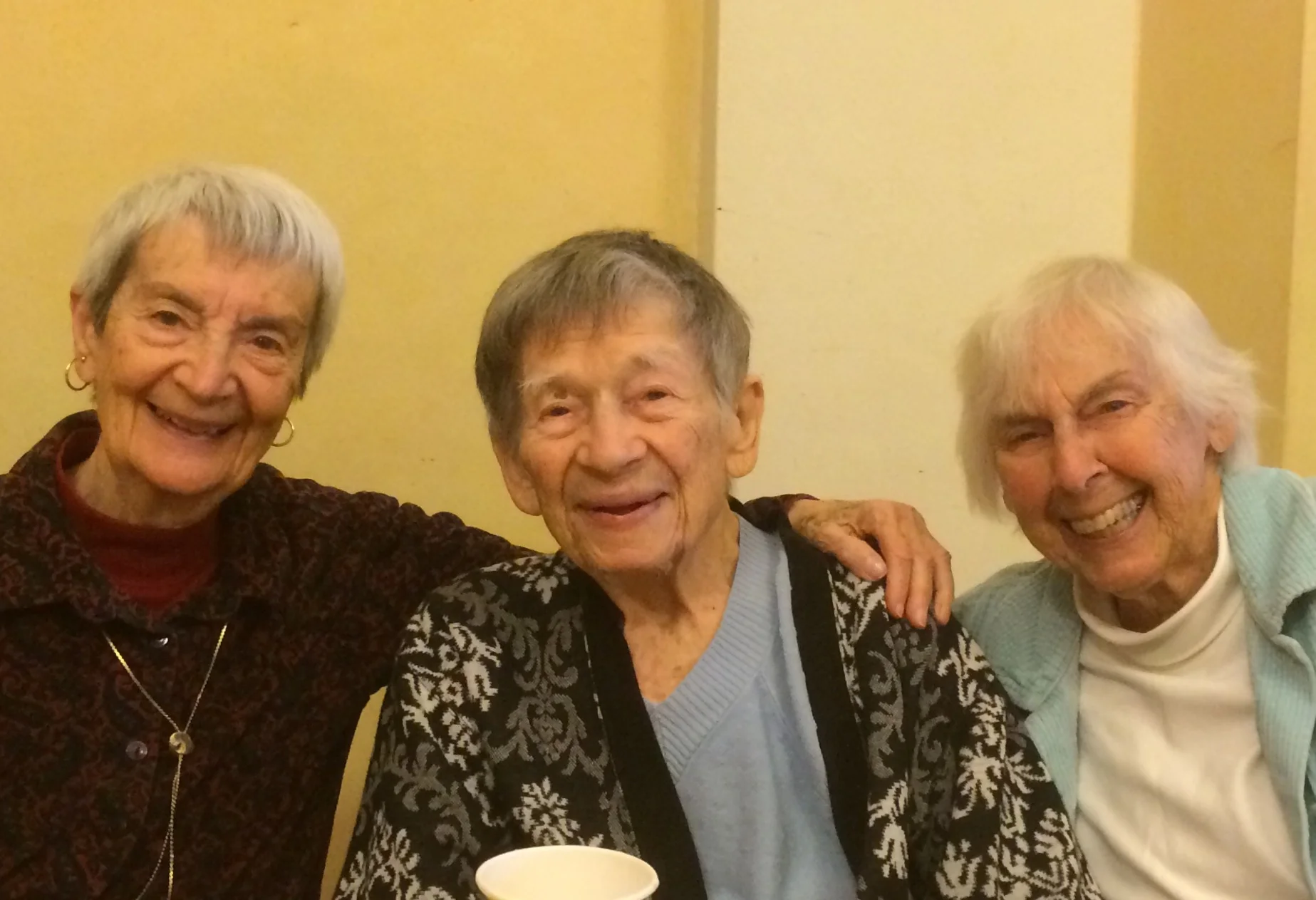
Doris, center, with friends at the Fellowship Community
For the hands that help,
For the hearts that care,
As often as she could, Doris came to the Otto Specht School to attend Friday morning assemblies, particularly in the last several weeks of her life. One day, after the assembly, she requested that her caregiver wheel her chair over to Jeanette. “Otto Specht is such a blessing for us all” Doris told Jeanette. “To see these children surrounded by such love, and to see them smiling and happy is such a miracle to me. I want to thank you so much for bringing all this light into the lives of us older people.” Jeanette, humbled, thanked her. Doris went on to say, “These children bring the future to us, and I so look forward to seeing them every Friday. It is a time to be thankful - every Friday. I hope the school grows and never leaves the Fellowship. It is the way to the future.”
For the good we have,
For the food we share,
In 1914, on the day after Purim, and just months before the start of the First World War, Doris Sacks (then Devorah Lew) was born in Bialystok (Poland), the youngest of three sisters. Her upbringing was not easy. When Doris was 8, she immigrated to the United States with her mother and sisters. At 16, she left school to work and help support her family. Doris quickly learned accounting and ran the offices for many businesses over the years. She enjoyed making the numbers work and whenever there was a problem, Doris looked at it as a puzzle, thereby gaining joy through solving it.
Most important to Doris was to love and be loved, truly and completely, and to have children to love with all her heart. It wasn’t until Doris was already in her mid-thirties, however, that she met her future husband, Arnold Sacks. Doris was told by a Doctor that she probably could not have children, but she and Arnold defied the odds, having two children.
And for the chance to live
And die
With Grace.
Doris loved. She loved her family fully and was much loved by them and her many friends. She loved knitting and reading, and spending time with the children in the community. She loved life and loved her independence. And life loved her, and didn’t want to let her go for a very long time. “During her last days,” her friend Dorothea remembers, “ it was like she was climbing a mountain to leave this world, and then, very gently, she spread her wings, and flew away.”
Lord
Thank you for this loving place
For the hands that help
For the hearts that care
For the good we have
For the food we share
And for the chance
To live and die
With Grace.
- Doris Sacks

#Giving Tuesday OSS 2018
Otto Specht School has joined #GivingTuesday, a pioneering effort to harness the collective power of partners charities, families, businesses, and individuals. The movement is transforming how people think, talk about, and participate in the giving season. Black Friday, Small Business Saturday, and Cyber Monday have become recognized days of holiday shopping. #GivingTuesday brings attention to philanthropy, donations, and kind actions - a movement we can really get behind!
Otto Specht School has joined #GivingTuesday, a pioneering effort to harness the collective power of partners charities, families, businesses, and individuals. The movement is transforming how people think, talk about, and participate in the giving season. Black Friday, Small Business Saturday, and Cyber Monday have become recognized days of holiday shopping. #GivingTuesday brings attention to philanthropy, donations, and kind actions - a movement we can really get behind!
This year, we are directing gifts on this national day of giving to support programming dedicated to lifelong learning through practical and vocational activities. These programs, which include farming, culinary skills, and the print shop, have very clear benefits to our students’ education, including practical application of academic material, executive functioning, and service to the community. Further development of these programs will increase our added value to the community and provide a springboard for students and young adults as they gain the skills and confidence to move towards further educational endeavors, independent living, and gainful employment. At Otto Specht School, we know that every child’s path will be unique but that each person deserves an opportunity to live fulfilling lives and follow his or her dreams.
The expanded programming will benefit from the diversity of our student body, the creativity of students and teachers, and the integration of the greater community. They will provide goods and services to the community, revenue for the school, and jobs for young adults with developmental disabilities. In order to fully implement the expansion of these programs, however, we need to improve the necessary spaces and equipment, including:
· Creating more work spaces (for culinary, book binding, and other activities)
· Renovating kitchen space
· Replacing outdated appliances
· Repairing greenhouses
These improvements are estimated at $25,000, our goal for #GIVINGTUESDAY

The Writing on the Wall
This year, the winner for Best Short Film at the Nyack Film Festival was “Writing on the Wall” by filmmaker Rob Barrett and singer/songwriter Sam Leopold. The film features footage of refugees crossing deserts, mountains, and seas, children clinging to their parents or to a few precious belongings. The topic is painfully current, and yet, as Sam will tell you – the writing has been on the wall for a very long time. His song, written nearly twenty years ago was prescient. At the time, few saw the problem of refugees coming on as hard and fast as is now happening.
Fifteen years after the release of the song, filmmaker Rob Barrett heard it and proposed the making of a short film based on the song. Sam agreed and they launched into the project without waiting to find investors. Over the next two years, local artists, activists, and inspired individuals from far and wide, participated in the project. A local documentarian and activist, Hassan Oswald, who traveled to Lesvos, Greece, to witness, help, and document the travails of the Syrian refugees coming ashore provided footage that became the basis for the film. Gaining rights to other footage was not without adventure. Most notably, a Brazilian professor of geography living in Malaga, Spain, inspired by the video’s message, got on a boat and travelled to Cueta, a Spanish region located on the northern coast of Africa across from Gibraltar. Upon landing, she took a taxi to the headquarters of Faro TV, where she spoke to the manager, and received written permission for Sam and Rob to use video footage owned by the station.
This year, the winner for Best Short Film at the Nyack Film Festival was “Writing on the Wall” by filmmaker Rob Barrett and singer/songwriter Sam Leopold. The film features footage of refugees crossing deserts, mountains, and seas, children clinging to their parents or to a few precious belongings. The topic is painfully current, and yet, as Sam will tell you – the writing has been on the wall for a very long time. His song, written nearly twenty years ago was prescient. At the time, few saw the problem of refugees coming on as hard and fast as is now happening.
Fifteen years after the release of the song, filmmaker Rob Barrett heard it and proposed the making of a short film based on the song. Sam agreed and they launched into the project without waiting to find investors. Over the next two years, local artists, activists, and inspired individuals from far and wide, participated in the project. A local documentarian and activist, Hassan Oswald, who traveled to Lesvos, Greece, to witness, help, and document the travails of the Syrian refugees coming ashore provided footage that became the basis for the film. Gaining rights to other footage was not without adventure. Most notably, a Brazilian professor of geography living in Malaga, Spain, inspired by the video’s message, got on a boat and travelled to Cueta, a Spanish region located on the northern coast of Africa across from Gibraltar. Upon landing, she took a taxi to the headquarters of Faro TV, where she spoke to the manager, and received written permission for Sam and Rob to use video footage owned by the station.
The video is not the end, however. In fact, Sam hopes it is the beginning of something larger. The writing on the wall, as we see in the video, is not just metaphorical. In the video, world-renowned Arabic calligrapher Elinor Aisha Holland, a local resident and long-time friend of Sam’s, is writing the Golden Rule in English and Arabic, as Sam writes it in Hebrew, while singing: “you can read it right to left or left to right, but you’ve got to read the writing on the wall!”
“Do unto others as you would have others do unto you.”
This literal writing on the wall is a call to action, a means by which today’s youth can create a new paradigm in dealing with humanitarian crises. It is a call to consider this simple, yet ancient principal for humanity, and to welcome world weary travelers into new lands, as has been the case since the beginning of history.
Sam Leopold has been making music professionally for decades. In addition to writing his personal music, he worked as a Music Specialist for Camp Venture, writing and making music with people with developmental disabilities. Work here included creating a rock band and writing songs that encompassed a variety of topics, including, notably, the game “connect four.” Sam began teaching music part time at Otto Specht several years ago, writing songs, having sing-alongs, and giving children an opportunity to experience a variety of instruments and their musical sounds. Sam has now joined Otto Specht full time and the students enjoy working with him and, of course, making music with him.
“Writing on the Wall” is particularly significant for Sam. The accolades accorded to the video are great, but more important to Sam is working towards a global reminding of the Golden Rule, especially for the young people coming of age amidst so much turmoil. Sam’s hope is that “this small effort here will inspire a few young people to inspire a few more young people and perhaps together they can make some difference.”
Sam, Rob and Aisha are currently working on a Spanish version of Writing on the Wall with additional footage from Argentina, Mexico, Texas and Puerto Rico.

Parent Spotlight: Shannon Young
One of the things that really helped me about living in Costa Rica was the peaceful acceptance of the vicissitudes of life so contrary to the New York high speed, high intensity attitude, where everything seems focused on achievement and beating the competition. Costa Ricans have a saying: “Pura Vida” which roughly means, relax and live life joyfully. In Costa Rica I was able to let go of much of my anxiety about all the developmental milestones that my son was not reaching, to practice more patience and acceptance of my son - and of myself with all of my hang ups.
Stories From the Cloud Forest to Home
Since Giancarlo was diagnosed with autism at age 2, my life went off in a completely unexpected trajectory. Giancarlo is now 16 going on 17 soon. He is a wonderful young man!
When Giancarlo was a youngster, a close friend of mine with a typically developing child asked me what it was like to have a child who wasn’t developing in the way that was expected. For her, things were laid out in advance: what to expect and how to facilitate her child’s development and help him to find himself. I told her that I am also doing what I think is best to help my child to reach his potential, but that for me the system is not laid out so clearly, making for an arduous journey.
After several years of disappointment, fighting the NYC school system, we left NY for the healing space of Costa Rica’s cloud forest. I took a year’s leave of absence from work as a university English professor, and this year turned into two. We lived up in the clouds and off the grid as much as possible. There was one line of electricity threaded 200 meters through the forest with its magnificently contorted strangler fig trees (so named because they strangle the life out of the host tree) to our rickety cabin, with one sink in the kitchen, an outhouse, and outdoor shower. We loved the immersion in the natural world that occurred there, even the frequent scorpions (non deadly variety) that would come into our far from airtight cabin to escape the rains. I would sit at my computer at night, with Giancarlo in bed, researching and writing, moths flying around my head, drawn to the light of the computer screen.
I focused my attention on how to help my son’s overly sensitive system to calm and function better, cooking nourishing foods, detoxing, practicing yoga and reiki, working with reading programs, auditory integration training, etc., etc. I would shut off the breakers to the house at night so we could sleep without exposure to electromagnetic radiation. Giancarlo was schooled at the farmhouse of a talented retired school teacher expatriot from Ohio, along with other kids who didn’t fit in the public school system there. His musical talent blossomed through piano lessons with a joyful and creative classically trained pianist expat from Canada. We went regularly to the beach, a four hours’ drive down a winding rutty, gravelly road, where swimming in the ocean and walks along the beach worked their healing magic on us both.


One of the things that really helped me about living in Costa Rica was the peaceful acceptance of the vicissitudes of life so contrary to the New York high speed, high intensity attitude, where everything seems focused on achievement and beating the competition. Costa Ricans have a saying: “Pura Vida” which roughly means, relax and live life joyfully. In Costa Rica I was able to let go of much of my anxiety about all the developmental milestones that my son was not reaching, to practice more patience and acceptance of my son - and of myself with all of my hang ups.
During these two years in Costa Rica, I became involved in a project telling stories of the Costa Rican women of the cloud forest zone; incredible stories of resilient, resourceful women who grew up with no running water or electricity, practice subsistence farming, and raise their families inundated by the incredible nature of the cloud forest. At the end of these two years, however, I had to return to the US or lose my job at the University. I could not imagine putting Giancarlo back into the throes of the NYC educational system, so I made arrangements for him to stay while I traveled back and forth to the US to teach my two semesters. During this year, I arranged a sabbatical to work on the book project I had begun during my leave of absence. In this way, I was able to resettle for a time in Costa Rica while immersing myself in visits to the fascinating women of the cloud forest. The book is now completed and under review at La Universidad Nacional of Costa Rica (the Spanish version which will be translated to English for publication in the US).
During my time in Costa Rica, I wondered perpetually about becoming one of the expats, even going so far as to purchase a piece of land in a wonderful valley, sloping down from the cloud forest. But my funds were low, and I didn’t want to give up my hard earned job as a tenured university professor. As my sabbatical was drawing to a close, I heard from a friend, Mary Holland, about a small school just upstate from NYC, called the Otto Specht School, and how much she and her son, Andy, loved it. Some phone calls and a Skype interview later, Giancarlo and I, and our little Costa Rican dog, Phoebe, returned to the US, filled with trepidation, and knowing that if it didn’t work out, we could always return to Costa Rica.
The community and the school have been a godsend for us. It amazes me that we have found such an incredible community of like-minded, soulful people in the United States. We love the Fiber Craft Studio, the Eurythmy performances, the Christian Community Church, Fridays - eating biodynamic meals and buying biodynamic produce at the Hand and Hoe, followed by evenings of live, local musicians and dinner at the Threefold Café. Most importantly, there is Otto Specht School, filled with heart, and a staff that appreciates my son and doesn’t overly problematize him. They focus on his strengths and many talents, like his music and art, not his deficits. Giancarlo loves working on the farm and wants to be a farmer.
And so, for now, we’ve let go of our life in Costa Rica - at least full-time. We still have our piece of land, and go back for extended stays each year. Now, I am working out a study abroad opportunity to bring students from my University to Costa Rica to write up oral histories of the inhabitants of the cloud forest, continuing on from my own rewarding work with the people and place that have become such a special part of my life.
Rudolf Steiner says, as quoted in this years’ yearbook: “We must look forward with absolute equanimity to everything that may come . . . and we must think only that whatever comes is given to us by world direction full of wisdom.” After much angst and bewilderment in my parenting role, and all the twists and turns that it has brought me, this is a profound encapsulation of what I came to understand. Life brings us precisely the challenges that we need in order to learn the things we need to learn. And without these obstacles and challenges I needed to face, I never would have found this community we now call home.

Welcome Home Otis
Zachary waited at the farm, hours after school had ended, excited to be the first student to meet our newest companion. As late afternoon cast long shadows across the pastures and the cows were in their yard after evening milking, a blue Jeep, pulling a trailer, turned into the red farm-gate. Otis! The appaloosa mustang looked around cautiously as he descended the ramp, assessing the pastures, taking note of the cows across the fence. “That’s a fine looking animal!” Will, the dairy farmer, said, nodding in approval. Zach stood near Otis’ head and offered a hand, allowing Otis to breathe him in – a horse’s equivalent of asking your name.


The next morning, Otis spent some time at the fence, eyeing his bovine neighbors, flaring his nostrils as he accustomed himself to their scent and all the other scents of the new air. The cows, equally curious, approached their side of the shared fence and watched Otis as he took graceful laps around the ring. Every few laps, Otis would halt right in front of the fence, and the cows, his awestruck spectators, would back off momentarily, startled by the unfamiliar creature. Later, all of the Otto Specht students gathered together to meet this new creature, who they would soon be learning and working with. A sign, painted by the students, hung from the railing of the corral, decorated with the students’ handprints and the words “Welcome Home Otis.”


Otis quickly settled into his new home, thrilled to have fresh grass, and becoming accustomed to, and even, it would seem, fond of the cows across the fence. The children gladly worked to care for the horse, mucking stalls, carrying water, and clearing undesired plants from the riding ring and debris from the paddock. Students found a sense of purpose working with Otis, which helped them brush aside other concerns and social anxieties and delve into the work. The fifth grade girls exclaimed that Mr. Bosch always knew the right jobs to give them when working with Otis. He knew who could stand mucking the stalls, and who could carry the heavy water buckets. Life lessons were also readily learned with Otis. The students could reflect upon themselves through what they learned about the horse. For example, they all learned that we do not feed Otis from our hands since he would get spoiled and then he would expect treats from us whenever he saw us and be disappointed when we didn’t have them. “What does that remind you of?” Mr. Bosch asked the third graders. “The red truck!” Ori quickly replied. “Exactly!” Mr. Bosch confirmed. “Ever since I gave you one ride in the red truck, you have asked for it every gardening class.” The third graders nodded. They understood this lesson, and look forward to many more.
Farm and Garden: Summer Update
As the school year drew to a close, harvests and seed saving filled our last days of Farming and Gardening. The spaces cared for by our students produced hundreds of pounds of food for the Fellowship Community kitchen. Beautiful dishes of fresh salads, carrots and radishes, warm, nourishing beet greens, and earthy, deep red beets brightened the tables of members, co-workers, and guests. Students joyfully sampled the vegetables they grew and delivered them to the kitchen with the pride of real farmers.
As the school year drew to a close, harvests and seed saving filled our last days of Farming and Gardening. The spaces cared for by our students produced hundreds of pounds of food for the Fellowship Community kitchen. Beautiful dishes of fresh salads, carrots and radishes, warm, nourishing beet greens, and earthy, deep red beets brightened the tables of members, co-workers, and guests. Students joyfully sampled the vegetables they grew and delivered them to the kitchen with the pride of real farmers.
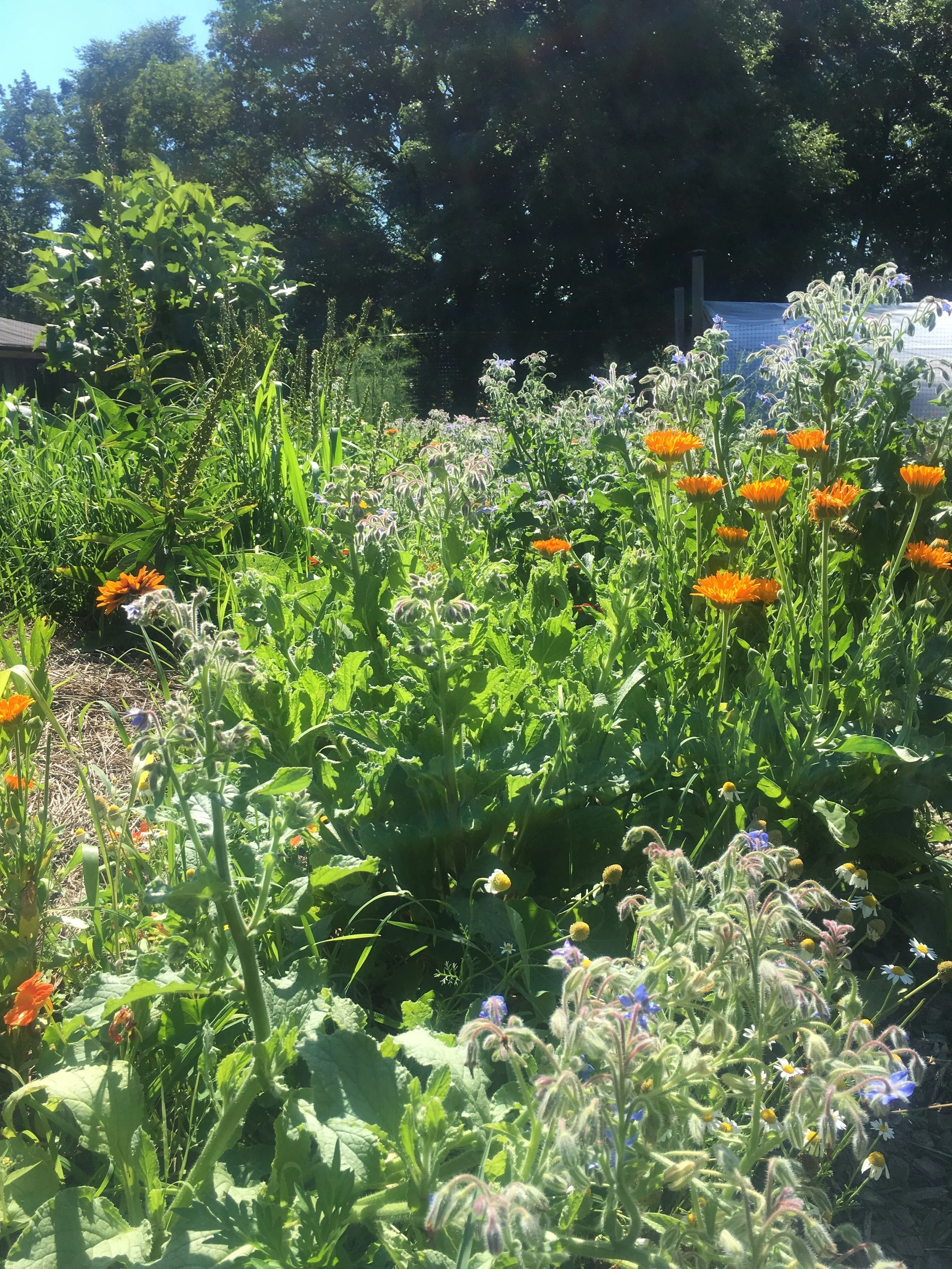
The medicinal garden entered its second season of blooming bounty as well in the last few weeks of school. All summer long, this garden will provide a workspace for our summer program, a haven for our dear pollinators, fresh herbs for the Fellowship Community, and the makings of future healing teas, sachets, tinctures and creams to get us through the winter months.

Bees...

And teas...
Central to all of our work on the land is the ongoing work of building relationships – amongst each other, with the broader community, and with the incredible vibrancy of the farm individuality that is unique in our school life. The opportunities that present themselves, for service and learning, in the gardens and on the farm, are endless as the students make connections between caring for the earth, the animals, themselves, and each other.
While summer students and teachers continue to care for the land throughout the summer, the seeds of next years programming, both literally and metaphorically, are already being sewn. Our seed saving program produced thousands of lettuce, beet, chard, and radish seeds for next years crops. In one greenhouse, oats, sewn to build biomass in the soil, are nearing the “milky oat stage,” when they can be harvested and dried for use in revitalizing and restorative herb teas. Plans are being made to repair another one of our greenhouses in the fall, with new beds to build and holes to patch, but for now, plants flourish in the steamy environment, which will bring a late summer harvest of tomatoes, squash, eggplants, peppers, and more.

Milky Oats

Summer Crops

Dropping Stitches: Why We Do Handwork
Handwork has a specific task within the curriculum. It awakens the creative powers which will be useful in as many ways as possible in later life and work. It helps the young child to develop a healthy imagination and helps to unfold his/her will and feeling life. What’s almost more important than the child learning to use his/her hands in a practical way is that in adult life, it will help form good judgement and balanced thinking.
In Handwork, we use mainly the right side of the brain (creativity, intuition), which helps the students crossing the “mid-line.” It requires the involvement of many skills including: body awareness, hand-eye coordination and possibly most importantly, brain communication.
“The human hand is an amazing tool. Our hands have strength, sensitivity, and memory. Using tools and making items we can use in everyday life defines us as human.” This includes knitting, crocheting, sewing, weaving and spinning.
Handwork is an important element in every Waldorf School. In addition to the reverence and wonder of what the students can create themselves, handwork promotes thinking and judgment, builds confidence, and develops patience as a handwork project can take some time from start to finish and moves the child from playing to working on a meaningful project. It also helps children to solve problems as they must notice mistakes and ways to fix them.
Handwork has a specific task within the curriculum. It awakens the creative powers which will be useful in as many ways as possible in later life and work. It helps the young child to develop a healthy imagination and helps to unfold his/her will and feeling life. What’s almost more important than the child learning to use his/her hands in a practical way is that in adult life, it will help form good judgement and balanced thinking.
In Handwork, we use mainly the right side of the brain (creativity, intuition), which helps the students crossing the “mid-line.” It requires the involvement of many skills including: body awareness, hand-eye coordination and possibly most importantly, brain communication.
At Otto Specht School, all students work with yarn which is plant dyed. It is said that colors from nature can have a positive impact on our wellbeing while working with it. These colors are more appreciated and understood than chemically dyed wool and it gives the students a reverence for the gifts nature provides. They also learn to use color in a more conscious way, working either from light to dark or from dark to light, depending on the project.
At the OSS school, most students follow the Waldorf handwork curriculum. Yet, depending on the child’s needs, the projects are adjusted and changed.
Generally, in 1st grade, the students learn how to knit, followed by crocheting in 2nd grade. Hand sewing, embroidery, weaving, knitting in the round and machine sewing will follow as the students move up the grades.
Handwork should be relaxing while at the same time involving and strengthening will activity. Each student’s completed project is the result of his or her own effort and brings satisfaction and enhanced self-esteem.


Going With the Grain: Why We Work With Wood
When a student enters the wood shop, she is welcomed into a space where she can use her hands, mind, imagination, senses of beauty and proportion, will power, and simple tools to create something beautiful. She is invited to look forward to the pride and satisfaction that her completed project will eventually bring. She is looking forward to success.
Woodworking requires that the maker engage all of his faculties in an integrated manner to transform organic material into something beautiful and useful. It requires purpose, patience, concentration, and commitment. Woodworking can also be fun! Social interaction is common and welcome, as long as it is not distracting or disruptive. Tools, especially ones that are cared for and well-maintained such as the ones we use, can be both highly satisfying and dangerous, and we work within clear safety guidelines, conscious of protecting ourselves and the others around us.
When a student enters the wood shop, she is welcomed into a space where she can use her hands, mind, imagination, senses of beauty and proportion, will power, and simple tools to create something beautiful. She is invited to look forward to the pride and satisfaction that her completed project will eventually bring. She is looking forward to success.
Woodworking requires that the maker engage all of his faculties in an integrated manner to transform organic material into something beautiful and useful. It requires purpose, patience, concentration, and commitment. Woodworking can also be fun! Social interaction is common and welcome, as long as it is not distracting or disruptive. Tools, especially ones that are cared for and well-maintained such as the ones we use, can be both highly satisfying and dangerous, and we work within clear safety guidelines, conscious of protecting ourselves and the others around us.
When working with the students, Dr. Karnow and I suggest projects that are appropriate for the skill levels of individual children, giving them some freedom to try options that are appealing. At any point in time, a wide variety of projects are in progress. We work with hand tools - saws, rasps, files, carving gouges, hand-planes, spoke shaves, mallets, hammers, screwdrivers, chisels, sandpaper, oils, and beeswax. We begin with wood blanks, describing the properties of the wood, paying attention to the direction and figuring of the grain, identifying the annual rings, and examining the relative hardness, strength, and workability of the wood for a given project. We call attention to the beauty of wood and try to impart a sense of reverence for it. Sometimes the children harvest the wood, such as felling a birch tree and sawing it into parts, allowing them to dry properly. This could become so many things, such as a beautiful garden gateway like we built last year for the Kindergarten.
Having been a teacher of high school mathematics in a Waldorf School, I observe the children in wood shop learning lessons about proportion, geometry, and numbers in ways that sink in. Finding the center of a rectangular board using diagonal lines, adding fractional numbers using two rulers side-by-side, forming curves, counting the strokes of a saw rhythmically by units, twos, threes, etc., are some of the many ways in which the students integrate knowledge that they will carry forward into the classroom and beyond.
Moral lessons happen too, without the need to lecture. “Good enough” is not part of a good woodworker’s vocabulary. A right angle is precisely 90 degrees. Corner mortices don’t work unless the complementary angles are exact. Measurement must be correct. Cuts must conform to careful measurement. Design needs to be informed by the skills of the maker, the properties of the material, and principles like integrity, simplicity, and grace. Each action has a consequence. When wood is removed it cannot be replaced. Mistakes inevitably happen and solutions need to be found without compromising the integrity of the finished product. “Good,” “true,” and “beautiful” are common words in a woodworker’s vocabulary.
Woodworking is about striving.